Medicare IRMAA Surcharges: Brackets & Form SSA-44 Appeals
Medicare IRMAA surcharges explained: the 5 income tiers, the 2-year lookback, and how Form SSA-44 can lower your premium after a life-changing event.

When individuals enroll in Medicare at age 65, they often anticipate paying a standard baseline premium for healthcare coverage. However, higher-earning households frequently receive an unexpected notice from the Social Security Administration announcing hundreds of dollars in additional monthly charges. These extra charges are known as the Income-Related Monthly Adjustment Amount (IRMAA).
Unlike progressive income tax brackets that only tax the dollars that exceed a boundary, IRMAA functions as a set of rigid financial cliffs. Crossing a statutory threshold by a single dollar triggers substantial monthly surcharges across both Medicare Part B and Medicare Part D. Understanding how these surcharges are calculated, and how to contest them through administrative appeals, is critical for protecting retirement cash flow.
[!NOTE] Key Takeaways & Strategic Summary
- Zero-Tolerance Cliffs: IRMAA tiers are strict cliffs rather than gradual phaseouts. Earning just $1.00 over a tier threshold subjects you to the full surcharge for all twelve months of the year.
- The 2-Year Lookback Rule: Your Medicare premiums today are determined by your federal tax return from two years prior. This administrative lag frequently penalizes new retirees whose current income is far lower than their peak career earnings.
- Comprehensive Part B and Part D Impact: IRMAA surcharges apply to both outpatient medical insurance (Part B) and prescription drug coverage (Part D). For a married couple, both spouses pay the surcharges, doubling the household penalty.
- Statutory Relief via Form SSA-44: If your income dropped due to one of eight qualifying life-changing events (such as retirement or work reduction), you can legally eliminate the surcharge by filing Form SSA-44.
What Is Medicare IRMAA and How Does the 2-Year Lookback Rule Work?
What exactly is Medicare IRMAA and why does it surprise so many affluent retirees? Established under the Medicare Modernization Act and expanded under subsequent federal legislation, IRMAA is an income-based surcharge added to standard Medicare premiums. It was designed to reduce federal healthcare subsidies for upper-income beneficiaries.
To determine whether you owe an IRMAA surcharge, the Social Security Administration evaluates your Modified Adjusted Gross Income (MAGI) using data transmitted directly from the Internal Revenue Service. Under statutory rules, the formula for IRMAA MAGI is specific:
$$\text{IRMAA MAGI} = \text{Adjusted Gross Income (Form 1040 Line 11)} + \text{Tax-Exempt Interest (Form 1040 Line 2a)}$$
Many investors mistakenly believe that holding municipal bonds shields them from Medicare surcharges. However, because tax-exempt interest is explicitly added back to calculate IRMAA MAGI, municipal bond income counts directly toward your tier thresholds. You can project your baseline household income using our MAGI calculator to monitor your distance from critical cliffs.
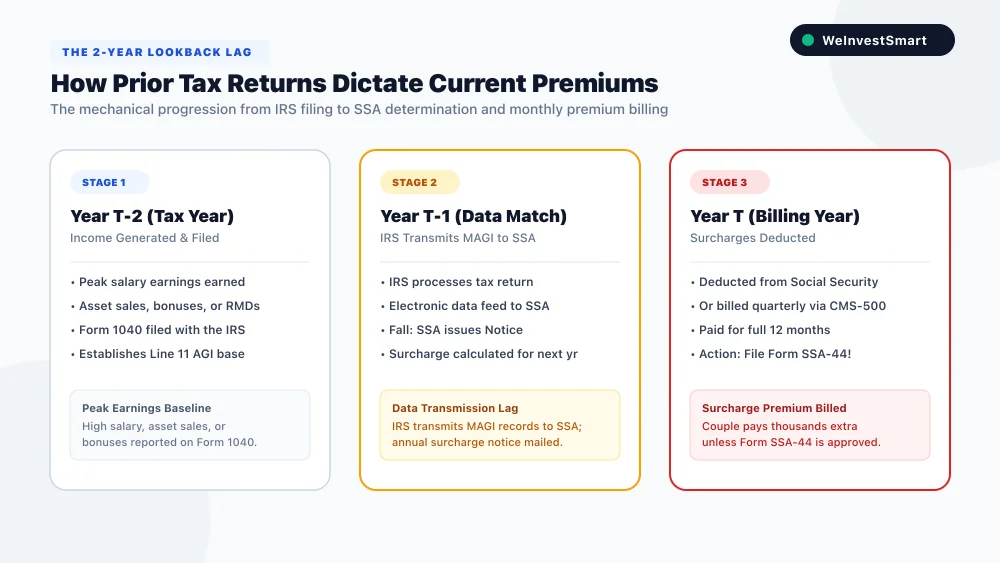
The primary reason IRMAA catches retirees by surprise is the statutory two-year lookback mechanism. The Social Security Administration establishes your premiums for the upcoming calendar year using tax returns filed for the tax year two years prior. For example, your Medicare premiums in 2026 are calculated using the income reported on your tax return from two years prior.
This two-year delay occurs because the IRS requires time to process tax returns, conduct annual audits, and electronically transmit data feeds to the Social Security Administration. When you retire at age 65 or 66, your Medicare premiums will reflect your peak employment earnings from ages 63 and 64. Without proactive planning or timely appeals, retirees find themselves paying executive-level healthcare premiums on a modest fixed retirement budget.
The 5-Tier Cliff Structure: Part B and Part D Surcharge Breakdown
How is the IRMAA surcharge structured and how much does it cost? IRMAA divides beneficiaries into five distinct income tiers above the standard base premium threshold. As detailed in our foundational guide on US stealth marginal tax traps, these tiers do not phase in gradually; they represent all-or-nothing cliffs.
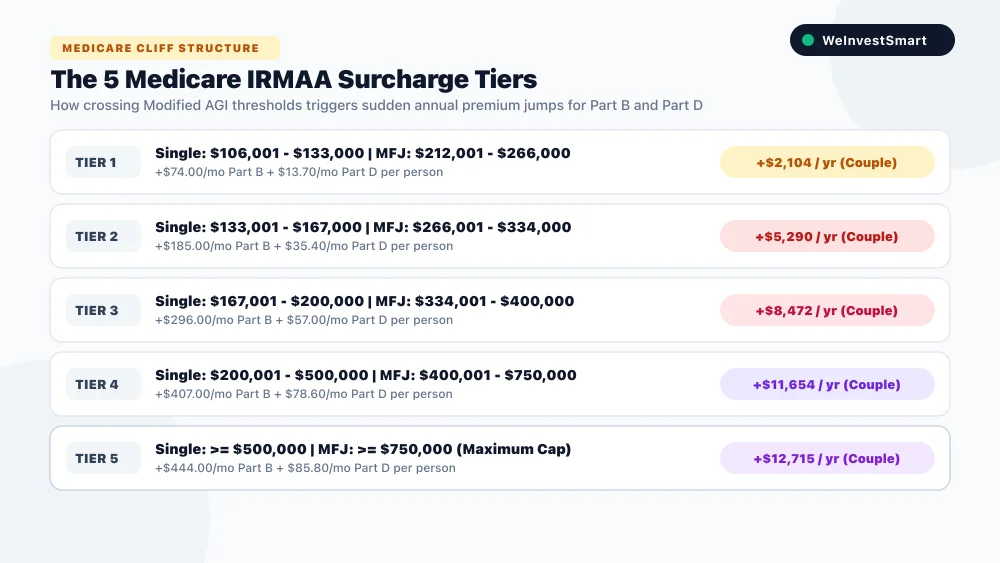
According to official Medicare costs and premium schedules, standard Medicare Part B covers 25% of the program’s actuarial cost, with the federal government subsidizing the remaining 75%. When your income crosses into IRMAA tiers, your personal share of the program costs rises systematically from 35% up to 85%.
The surcharge applies across two independent components of Medicare:
- Medicare Part B (Medical Insurance): The monthly surcharge is added directly to your standard Part B monthly premium. For most beneficiaries collecting Social Security, this total amount is deducted automatically from their monthly benefit check.
- Medicare Part D (Prescription Drug Coverage): If you enroll in a standalone Medicare Part D plan or a Medicare Advantage plan that includes prescription drug coverage, you pay an additional monthly IRMAA fee. This fee is paid directly to Medicare or deducted from Social Security, entirely separate from your private insurance plan premium.
For married couples filing jointly, each spouse is evaluated using the combined household MAGI. If both spouses are enrolled in Medicare Part B and Part D, both individuals are assessed the full surcharge for their respective tier. Consequently, the dollar cost to the household is double the individual surcharge amount.
Complete Reference Matrix: IRMAA Tiers, Monthly Costs, and Annual Surcharges
To evaluate the exact financial drag of crossing an IRMAA threshold, examine the statutory tier matrix below. The dollar figures reflect standard program distributions and official adjustment formulas.
| IRMAA Tier | Single Filer MAGI | Married Filing Jointly MAGI | Monthly Part B Surcharge (Per Person) | Monthly Part D Surcharge (Per Person) | Combined Annual Surcharge (Individual) | Combined Annual Surcharge (Married Couple) |
|---|---|---|---|---|---|---|
| Standard (Tier 0) | $106,000 or less | $212,000 or less | $0.00 | $0.00 | $0.00 | $0.00 |
| Tier 1 (35% Share) | $106,001 to $133,000 | $212,001 to $266,000 | +$74.00 | +$13.70 | +$1,052.40 | +$2,104.80 |
| Tier 2 (50% Share) | $133,001 to $167,000 | $266,001 to $334,000 | +$185.00 | +$35.40 | +$2,644.80 | +$5,289.60 |
| Tier 3 (65% Share) | $167,001 to $200,000 | $334,001 to $400,000 | +$296.00 | +$57.00 | +$4,236.00 | +$8,472.00 |
| Tier 4 (80% Share) | $200,001 to $500,000 | $400,001 to $750,000 | +$407.00 | +$78.60 | +$5,827.20 | +$11,654.40 |
| Tier 5 (85% Share) | Greater than $500,000 | Greater than $750,000 | +$444.00 | +$85.80 | +$6,357.60 | +$12,715.20 |
For married individuals who choose to file separately after living together at any time during the year, Congress enforces exceptionally punitive thresholds. Married filing separately beneficiaries face Tier 4 surcharges on MAGI between $106,000 and $394,000, and hit maximum Tier 5 surcharges at just $394,000.
Case Studies: Modeling the Cost of the $1.00 IRMAA Cliff Trap
How does the cliff structure penalize unsuspecting households in practice? The following two real-world case studies illustrate the mathematical trap of crossing an IRMAA threshold by a nominal amount.
Case Study 1: The $1.00 Capital Gain Cliff
Richard and Linda are married filing jointly, both aged 67 and enrolled in Medicare Parts B and D. During their lookback filing tax year, their combined retirement income consisted of $60,000 in Social Security benefits, $90,000 in traditional IRA distributions, and $62,000 in taxable portfolio dividends, giving them a baseline MAGI of $212,000.
In late December of that tax year, Richard rebalanced a small stock position in their taxable brokerage account, generating an unexpected $100 net capital gain. This transaction brought their total lookback MAGI to $212,100, exactly $100 above the Tier 1 threshold.
The table below illustrates the financial consequence of this $100 gain:
| Metric | Baseline ($212,000 MAGI) | New Scenario ($212,100 MAGI) | Net Difference |
|---|---|---|---|
| Gross Incremental Income | $0.00 | +$100.00 | +$100.00 |
| Federal Long-Term Capital Gains Tax (15%) | $0.00 | -$15.00 | -$15.00 |
| Richard’s Part B Surcharge ($74/mo x 12) | $0.00 | -$888.00 | -$888.00 |
| Richard’s Part D Surcharge ($13.70/mo x 12) | $0.00 | -$164.40 | -$164.40 |
| Linda’s Part B Surcharge ($74/mo x 12) | $0.00 | -$888.00 | -$888.00 |
| Linda’s Part D Surcharge ($13.70/mo x 12) | $0.00 | -$164.40 | -$164.40 |
| Total Out-of-Pocket Cost for the Year | $0.00 | -$2,119.80 | -$2,119.80 |
By realizing that additional $100 of capital gain, Richard and Linda incurred $2,104.80 in Medicare surcharges plus $15 in capital gains tax. On that incremental $100 of earnings, their effective marginal tax rate was 2,119.8%.
Running prospective transactions through our gross to net calculator helps you avoid making small year-end financial moves that trigger outsized healthcare fees.
Case Study 2: Peak Career Salary vs. Early Retirement Reality
Susan retired from her role as an engineering director at age 65 during her lookback tax year. During that final working year, she earned a salary of $175,000. In her subsequent retirement coverage year, her retirement income dropped to $55,000, funded by Social Security and a modest pension.
Prior to her retirement coverage year, Susan received an initial determination notice from the Social Security Administration informing her that her upcoming Medicare premiums would be placed in IRMAA Tier 3 based on her prior tax return.
Here is the financial breakdown of her initial determination:
| Item | Monthly Amount | Annual Cost |
|---|---|---|
| Standard Medicare Part B Premium | $185.00 | $2,220.00 |
| Tier 3 Part B Surcharge | +$296.00 | +$3,552.00 |
| Base Part D Drug Plan Premium | $45.00 | $540.00 |
| Tier 3 Part D Surcharge | +$57.00 | +$684.00 |
| Total Annual Healthcare Cost (Initial) | $583.00 / month | $6,996.00 / year |
Because her prior career salary was $175,000, Susan faced $4,236 in annual IRMAA surcharges during a year when her actual income was only $55,000. Fortunately, because Susan stopped working, she qualifies for administrative relief under federal regulations.
How to Appeal IRMAA Surcharges: The 8 Qualifying Events and Form SSA-44 Protocol
Can you legally challenge an IRMAA surcharge if your current financial reality no longer reflects your past tax returns? Yes, federal regulations provide a structured appeals process for beneficiaries who meet specific statutory criteria.
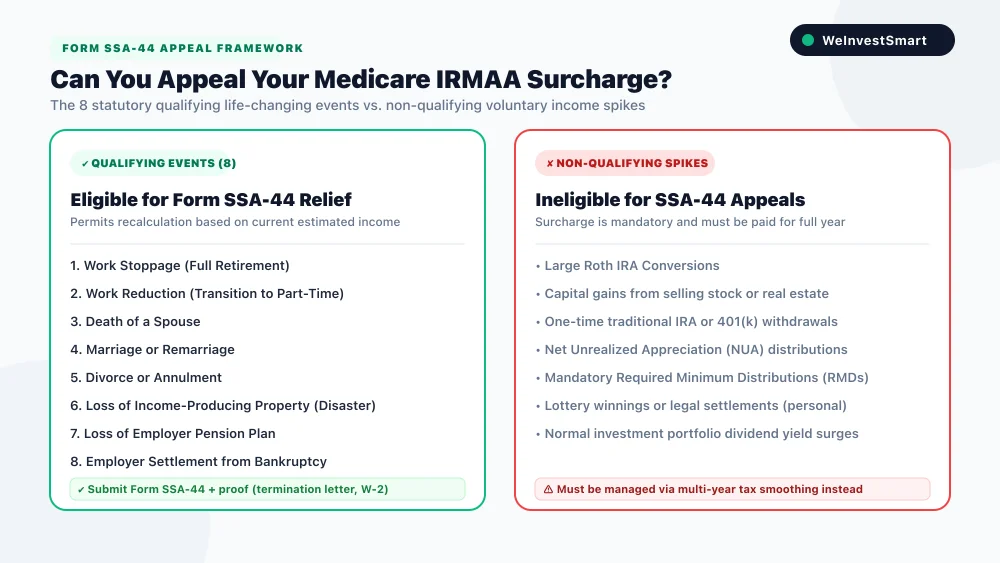
The 8 Statutory Qualifying Life-Changing Events
Under Social Security Administration regulations, you cannot appeal an IRMAA surcharge simply because you disagree with the cost or because your investments dropped in value. To obtain a new initial determination, your reduction in income must be caused by one of eight recognized life-changing events:
- Work Stoppage: Complete retirement from employment or self-employment.
- Work Reduction: Transitioning from full-time employment to part-time hours, or taking a substantial pay cut.
- Death of a Spouse: The passing of your spouse, which often reduces household income and changes filing status from MFJ to Single.
- Marriage: Entering a marriage that alters your household income and filing status.
- Divorce or Annulment: The legal dissolution of a marriage.
- Loss of Income-Producing Property: Destruction of rental property or business assets due to a natural disaster, casualty, or fraud beyond your control.
- Loss of Pension Income: The termination, default, or cessation of an employer defined benefit pension plan.
- Employer Settlement: Receipt of a settlement from an employer resulting from the company bankruptcy or reorganization.
Non-Qualifying Events That SSA Rejects
The Social Security Administration will strictly deny appeals based on voluntary income events. The following situations do not qualify for an SSA-44 appeal:
- Large Roth IRA conversions executed to optimize future taxes
- One-time capital gains from selling stocks, mutual funds, or cryptocurrency
- Gain on the sale of a primary residence or vacation home
- Large lump-sum withdrawals from traditional IRAs or 401(k) accounts
- Mandatory Required Minimum Distributions (RMDs) from retirement accounts
- Winning the lottery or receiving a personal legal settlement
In these non-qualifying situations, you must absorb the surcharge for the full twelve-month coverage year. Once two years have elapsed and your income returns to baseline, the surcharge drops off automatically.
The 5-Step Protocol to File Form SSA-44
If you experienced a qualifying life-changing event, follow this five-step operational roadmap to request an immediate premium recalculation:
Step 1: Download Official Form SSA-44
Obtain the official form directly from the Social Security Administration Form SSA-44 portal. The form is titled Medicare Income-Related Monthly Adjustment Amount - Life-Changing Event.
Step 2: Select Your Qualifying Life-Changing Event
In Step 1 of the form, check the box corresponding to your specific qualifying event and record the exact date the event occurred. For example, if your retirement occurred on December 31 of your lookback tax year, record that exact date.
Step 3: Estimate Your Current Year Taxable Income
In Step 2 of the form, provide an estimate of your Adjusted Gross Income and tax-exempt interest for the current coverage year. You must project your income conservatively and realistically. If your actual year-end income exceeds your estimate, the SSA will reconcile the difference and bill you retroactively.
Step 4: Gather Mandatory Corroborating Evidence
You must provide official documentation verifying both the occurrence of the life-changing event and your projected income reduction. Acceptable proof includes:
- For Work Stoppage or Reduction: A signed letter from your former employer on company letterhead detailing your retirement date, or your final Form W-2 showing reduced earnings.
- For Death of a Spouse: An official certified copy of the death certificate.
- For Divorce: A signed court decree of absolute divorce or dissolution.
- For Income Verification: A copy of your most recently filed federal income tax return, or pay stubs reflecting reduced hours.
Step 5: Submit the Completed Packet to Your Local SSA Office
Deliver your signed Form SSA-44 and original supporting documents to your local Social Security Administration field office. You can submit the packet by certified mail or schedule an in-person appointment. Once approved, the SSA will adjust your monthly premiums and credit any overpaid surcharges back to your account.
Proactive Tax Planning: How to Keep Income Below IRMAA Thresholds
What steps can you take if your elevated income is driven by investment distributions rather than a qualifying life event? Because voluntary transactions cannot be appealed, proactive tax smoothing is your primary defense against IRMAA cliffs.
1. Execute Roth Conversions During Low-Income “Gap Years”
The optimal time to convert pre-tax traditional retirement balances is between retirement age and age 63. Because the IRMAA lookback begins at age 63 (two years prior to Medicare eligibility at age 65), conversions executed before age 63 will never trigger healthcare surcharges.
As outlined in our guide on advanced Roth conversion strategies, converting pre-tax assets early prevents large Required Minimum Distributions later in life. Defusing your pre-tax balances before age 73 ensures mandatory distributions do not push your income over Tier 1 and Tier 2 cliffs in your late sixties and seventies.
2. Utilize Qualified Charitable Distributions (QCDs)
For charitably minded retirees aged 70½ and older, Qualified Charitable Distributions provide an exceptional tool to manage IRMAA. Under federal tax law, you can transfer up to $108,000 annually per person directly from an IRA to a qualified 501(c)(3) charity.
Because QCD funds bypass Form 1040 Line 11 entirely, they do not appear in your Adjusted Gross Income or your IRMAA MAGI. Using a QCD to satisfy your annual RMD allows you to fulfill your charitable intentions while keeping your reported income safely below the nearest IRMAA threshold.
3. Practice Disciplined Capital Gain Spreading
If you own appreciated assets in taxable brokerage accounts, avoid liquidating large positions in a single tax year. Spreading sales across multiple calendar years prevents sudden MAGI spikes that trigger top-tier IRMAA penalties.
When selling commercial real estate or private business interests, evaluate an installment sale under Internal Revenue Code Section 453. Spreading capital gain recognition across a multi-year promissory note keeps each annual gain manageable, preserving your standard Medicare premium status.
Frequently Asked Questions About Medicare IRMAA and Form SSA-44
What is Medicare IRMAA and who has to pay it?
Medicare IRMAA (Income-Related Monthly Adjustment Amount) is an additional surcharge added to Medicare Part B and Part D premiums for higher-income beneficiaries. It applies to individuals whose Modified Adjusted Gross Income exceeds statutory thresholds based on their tax return from two years prior.
Can I appeal an IRMAA surcharge if I recently retired?
Yes, retirement qualifies as a statutory work stoppage under Social Security Administration guidelines. By filing Form SSA-44 alongside proof of retirement, you can request that Medicare base your current premiums on your estimated current income rather than your prior peak-earning tax return.
Does a one-time capital gain or Roth conversion qualify for an IRMAA appeal?
No, one-time investment gains, property sales, and voluntary Roth IRA conversions do not meet the legal definition of a qualifying life-changing event under 20 CFR Section 418.1205. In these circumstances, the IRMAA surcharge must be paid for the designated 12-month calendar year.
How does tax-exempt municipal bond interest affect Medicare IRMAA?
Tax-exempt municipal bond interest reported on Form 1040 Line 2a is added back to Adjusted Gross Income to determine your IRMAA Modified AGI. Consequently, investing in municipal bonds does not shield you from Medicare premium surcharges.
This article is for educational purposes only and should not be considered personalized financial advice. Consider consulting with a financial advisor for guidance specific to your situation.
For educational purposes. Consider your own circumstances before making financial decisions. Read our editorial policy.
From reading to planning
Explore the numbers for yourself.
Use our free calculators to compare scenarios and understand your options.