Advanced Roth Conversions: Pro-Rata, Mega Backdoor & NUA
Advanced Roth conversions for high earners: avoid the pro-rata rule with a reverse rollover, use after-tax 401(k) money, and weigh NUA. See each step.
High-income professionals frequently discover that standard financial advice stops working once household earnings cross $200,000. Statutory income phaseouts quietly lock you out of direct Roth IRA contributions, leaving surplus savings exposed to annual capital gains taxes in standard brokerage accounts.
Leaving significant retirement wealth trapped in traditional tax-deferred accounts creates a compounding tax problem. Decades of compound growth generate enormous pre-tax balances that trigger steep required minimum distributions (RMDs), higher Medicare premiums, and elevated tax brackets in retirement.
Advanced Roth conversion architectures solve this dilemma. By combining multi-step rollover mechanics, statutory exemptions, and coordinated employer-plan provisions, high earners can lawfully funnel tens of thousands of dollars into permanent tax-free growth each year.
Key Takeaways
- Direct Roth IRA contributions phase out between $153,000 and $168,000 for single filers, and $242,000 to $252,000 for married couples, but legal conversion pathways remain fully uncapped.
- The IRS pro-rata rule under Internal Revenue Code Section 408(d)(2) aggregates all traditional, SEP, and SIMPLE IRAs on December 31, taxing conversions proportionally unless pre-tax balances are isolated.
- Executing a 401(k) reverse rollover legally shelters pre-tax IRA assets inside an employer plan, resetting your individual IRA balance to zero and unlocking 100% tax-free backdoor conversions.
- The Mega Backdoor Roth leverages the overall annual additions ceiling under Internal Revenue Code Section 415(c) to shelter up to $72,000 annually through voluntary after-tax contributions and in-plan conversions.
- Net Unrealized Appreciation (NUA) under Internal Revenue Code Section 402(e)(4) allows employees holding heavily appreciated company stock to harvest long-term capital gains tax rates instead of paying high ordinary income rates.
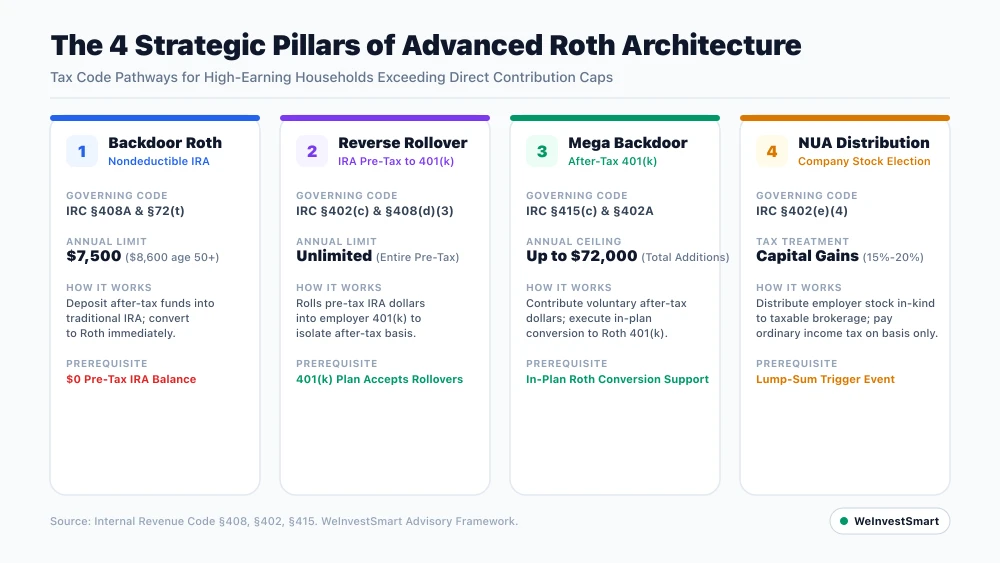
The 4 Strategic Pillars of Advanced Roth Architecture
Advanced Roth conversion strategies allow affluent earners to bypass statutory income limits, shelter massive capital within tax-free accounts, and protect against future tax rate hikes through four core mechanisms: the Backdoor Roth, the 401(k) Reverse Rollover, the Mega Backdoor Roth, and Net Unrealized Appreciation.
Direct contributions to a Roth IRA are governed by strict income limitations. When your modified adjusted gross income exceeds the statutory threshold, the IRS completely disallows direct deposits. However, the Tax Increase Prevention and Reconciliation Act of 2005 permanently removed the $100,000 income restriction on Roth conversions.
This statutory opening created the foundation for modern advanced wealth architecture. Instead of depositing money directly into a Roth IRA, you fund an intermediate vehicle and transition the capital across tax boundaries, as examined in our analysis of Roth vs Traditional retirement withdrawals.
The table below outlines the four primary mechanisms affluent households use to move assets into tax-sheltered environments:
| Strategy | Primary Mechanism | Governing Tax Code | Typical Annual Capacity | Core Tax Advantage |
|---|---|---|---|---|
| Backdoor Roth IRA | Nondeductible Traditional IRA contribution converted to Roth | IRC §408A & §72(t) | Up to $7,500 ($8,600 if age 50+) | Permanent tax-free compounding for high-income earners |
| 401(k) Reverse Rollover | Transfer pre-tax IRA balances into active employer 401(k) | IRC §402(c) & §408(d)(3) | Unlimited pre-tax IRA balance | Cleanses IRA balance to bypass the pro-rata tax rule |
| Mega Backdoor Roth | Voluntary after-tax 401(k) contributions converted in-plan | IRC §415(c) & §402A | Up to $72,000 (minus deferrals & match) | Massive annual tax-free savings volume |
| Net Unrealized Appreciation (NUA) | In-kind lump-sum distribution of employer company stock | IRC §402(e)(4) | Total value of company stock held in plan | Converts ordinary income tax rates into capital gains rates |
Selecting the right strategy depends on your employer plan rules, your current non-Roth IRA balances, and the specific distribution of company stock inside your retirement plans. Many affluent families combine multiple pillars simultaneously to maximize tax efficiency.
The IRS Pro-Rata Rule Trap: Understanding IRC Section 408(d)(2)
The IRS pro-rata rule mandates that when you convert funds from a traditional IRA to a Roth IRA, you cannot isolate only after-tax dollars. The IRS treats all your non-Roth IRAs as a single combined account on December 31 of the conversion year, taxing the conversion proportionally.
Many investors make a nondeductible contribution of $7,500 to a brand-new traditional IRA, convert that exact balance to a Roth IRA, and expect zero tax liability. If you hold existing pre-tax money in any rollover IRA, SEP-IRA, or SIMPLE IRA, that assumption triggers an expensive tax surprise.
Under Internal Revenue Code Section 408(d)(2), the IRS enforces an aggregation rule. The agency views all of your individual retirement arrangements as one collective pool of money. When you request a conversion, the IRS determines the taxable amount based on your overall ratio of pre-tax dollars to after-tax basis.
The taxable portion of your conversion is calculated using the following statutory formula:
$$\text{Tax-Free Ratio} = \frac{\text{Total After-Tax Basis}}{\text{Total Year-End Non-Roth IRA Balance} + \text{Conversion Amount}}$$
Consider an investor named Marcus. Marcus has a $92,500 rollover IRA from a previous employer consisting entirely of deductible pre-tax contributions and earnings. In March, Marcus contributes $7,500 in after-tax nondeductible money to a new traditional IRA and immediately converts that $7,500 to his Roth IRA.
Marcus believes he converted his $7,500 after-tax contribution tax-free. However, his total IRA balance across both accounts equals $100,000. His after-tax basis represents just 7.5% of his total IRA holdings ($7,500 divided by $100,000).
| Marcus’s Account Component | Balance | Portfolio Percentage | Tax Status on Conversion |
|---|---|---|---|
| Pre-Tax Rollover IRA | $92,500 | 92.5% | Fully Taxable Ordinary Income ($6,937.50) |
| After-Tax Traditional IRA Basis | $7,500 | 7.5% | Tax-Free Return of Capital ($562.50) |
| Combined IRA Portfolio | $100,000 | 100.0% | Total Converted: $7,500 |
When Marcus files his tax return, $6,937.50 of his $7,500 conversion is classified as ordinary taxable income. He must pay tax on that amount at his top marginal tax rate, defeating the primary purpose of the maneuver. For a detailed line-by-line Form 8606 walkthrough, review our guide to the Backdoor Roth pro-rata rule trap.
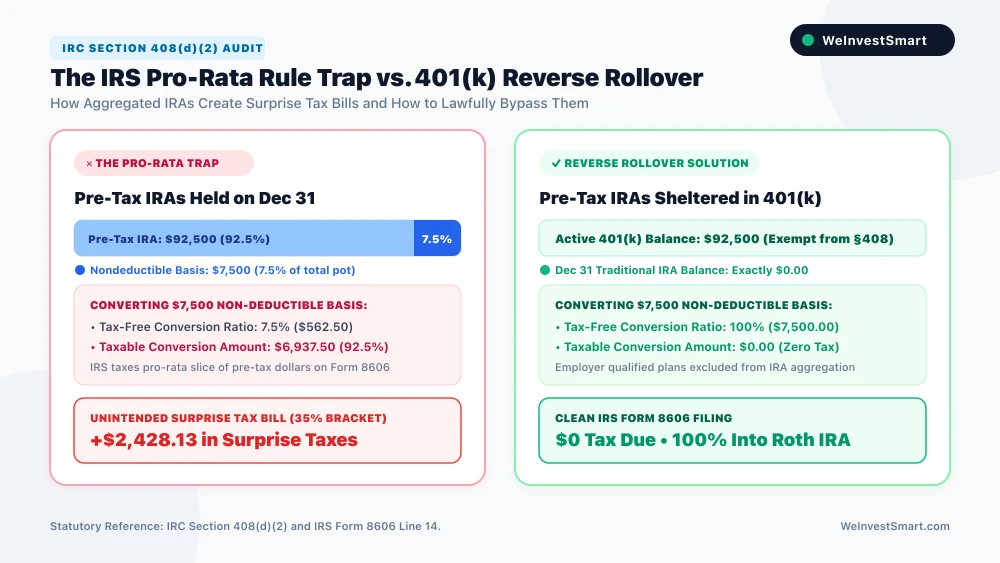
[!WARNING] The IRS measures your total pre-tax IRA balances on December 31 of the calendar year in which the conversion occurs, not on the specific date you execute the transaction. Opening a rollover IRA later in the year retroactively triggers the pro-rata rule on earlier conversions.
To maintain compliance and document after-tax basis, you must file IRS Form 8606 with your annual Form 1040. In addition, IRS Publication 590-B provides detailed distribution worksheets to verify how basis and taxable gains are reported across calendar tax years.
The 401(k) Reverse Rollover: How to Cleanse Pre-Tax IRA Balances
An upstream transfer known as a 401(k) reverse rollover transfers pre-tax assets from traditional, SEP, or SIMPLE IRAs into an employer-sponsored qualified plan. Because employer 401(k) accounts are exempt from Section 408(d)(2) aggregation, this maneuver reduces your IRA balance to zero, unlocking tax-free backdoor conversions.
The legal mechanism behind this strategy lies in account classification. Employer-sponsored retirement plans established under Internal Revenue Code Section 401(a), Section 401(k), Section 403(b), or governmental Section 457(b) are qualified plans under ERISA. They are not classified as individual retirement arrangements under Section 408.
Because employer plans are legally excluded from the December 31 aggregation calculation, moving pre-tax IRA funds into your company 401(k) isolates your after-tax IRA dollars. Once your traditional IRA contains only basis, you can convert the entire remaining balance to a Roth IRA with zero tax liability, reversing the common trap of contaminating personal IRAs with old company rollovers.
| Implementation Step | Action Required | Resulting Account State | Tax Impact |
|---|---|---|---|
| Step 1: Execute Reverse Rollover | Transfer pre-tax IRA balances into active employer 401(k) | Traditional IRA balance drops to $0 | $0 taxable event; institutional direct transfer |
| Step 2: Fund Traditional IRA | Deposit annual nondeductible contribution | Traditional IRA holds 100% after-tax basis | $0 deduction claimed on Form 1040 |
| Step 3: Convert to Roth IRA | Convert full Traditional IRA balance to Roth IRA | Traditional IRA returns to $0 balance | 100% tax-free conversion reported on Form 8606 |
Before initiating a reverse rollover, verify that your employer plan accepts incoming rollovers. Most corporate plans permit transfers of pre-tax IRA balances, but plan administrators rarely accept after-tax IRA contributions.
Ensure you request a direct institutional transfer rather than an indirect 60-day rollover. In a direct institutional rollover, the custodian makes the check payable directly to your employer plan administrator for your benefit. This avoids the mandatory 20% federal tax withholding applied to indirect distributions.
If your employer plan does not accept incoming rollovers, you have two alternatives. You can leave the pre-tax funds in place and delay backdoor conversions, or you can open an individual Solo 401(k) if you generate eligible 1099 self-employment income from consulting or freelancing.
The Mega Backdoor Roth: Sheltering up to $72,000 Under Section 415(c)
The Mega Backdoor Roth is an employer retirement plan strategy where employees make voluntary after-tax contributions beyond the standard $24,500 elective deferral up to the Section 415(c) annual limit of $72,000, immediately converting those funds to Roth status.
Standard 401(k) plans restrict employee salary deferrals to $24,500 per year (or $32,500 for employees age 50 and older). While this tax deferral is valuable, it represents only a fraction of the total savings capacity authorized by federal law.
Under IRC Section 415(c), Congress establishes an overall annual additions limit for defined contribution plans. For 2026, the statutory ceiling is $72,000 per participant. This limit encompasses three distinct contribution sources:
- Employee Elective Deferrals: Pre-tax or Roth salary contributions (capped at $24,500).
- Employer Contributions: Company matching funds and non-elective profit-sharing contributions, which you can optimize by capturing your full company match.
- Voluntary After-Tax Contributions: Additional employee deposits made with post-tax dollars beyond the elective deferral limit.
The mathematical capacity for a Mega Backdoor Roth is calculated by subtracting your elective deferral and employer match from the Section 415(c) limit:
$$\text{After-Tax Capacity} = $72,000 - \text{Employee Elective Deferrals} - \text{Employer Match}$$
For example, consider an engineer earning $220,000 whose employer provides a 50% match on the first 6% of salary ($6,600). The engineer contributes the maximum $24,500 in elective deferrals.
| Contribution Tier | Allocation Amount | Running Total Toward §415(c) | Tax Characterization |
|---|---|---|---|
| Employee Elective Deferral | $24,500 | $24,500 | Pre-Tax or Designated Roth 401(k) |
| Employer Matching Contribution | $6,600 | $31,100 | Pre-Tax Employer Additions |
| Remaining Voluntary After-Tax Space | $40,900 | $72,000 | Voluntary After-Tax (Converted to Roth) |
By allocating $40,900 into the after-tax portion of the 401(k) plan, the engineer can shelter substantial additional savings beyond standard account limits.
To convert these after-tax dollars into tax-free Roth status, your employer plan must support one of two statutory transaction types:
- Automated In-Plan Roth Conversion (IRR): The 401(k) recordkeeper automatically sweeps voluntary after-tax contributions into the plan’s designated Roth 401(k) sub-account daily or per pay period.
- In-Service Non-Hardship Distribution: The plan permits you to roll after-tax funds out of the 401(k) into an external personal Roth IRA while remaining actively employed.
Executing the conversion immediately after contribution is essential. Any investment earnings accrued while dollars sit in the after-tax bucket are classified as pre-tax income. Converting accumulated earnings generates ordinary taxable income on the growth, whereas converting immediately ensures a completely tax-free transaction.
Net Unrealized Appreciation (NUA): When Capital Gains Beat a Roth Conversion
Net Unrealized Appreciation (NUA) under IRC Section 402(e)(4) allows departing employees to distribute employer stock from a qualified plan to a taxable brokerage account, paying ordinary income tax only on the original cost basis while preserving long-term capital gains tax rates on the entire growth.
When preparing to roll over an employer retirement plan after leaving a company, most advisors automatically recommend rolling all assets into a traditional or Roth IRA. While that advice works for standard index funds, it can be a costly mistake for employees holding highly appreciated company stock.
When pre-tax assets reside inside an IRA, all future distributions are taxed at ordinary income rates, which reach as high as 37% at the federal level. By contrast, capital gains rates top out at 20% (plus the 3.8% Net Investment Income Tax) under standard capital gains tax brackets.
Under IRC Section 402(e)(4), Net Unrealized Appreciation allows you to harvest this rate arbitrage:
[!TIP] Under the NUA rule, you distribute actual employer stock shares in-kind to a taxable brokerage account, paying ordinary income tax only on the original cost basis in the year of distribution. All other plan assets (bonds, diversified index funds, cash) are rolled into a standard Rollover IRA. When you eventually sell the stock shares, the entire embedded growth is taxed at favorable long-term capital gains rates.
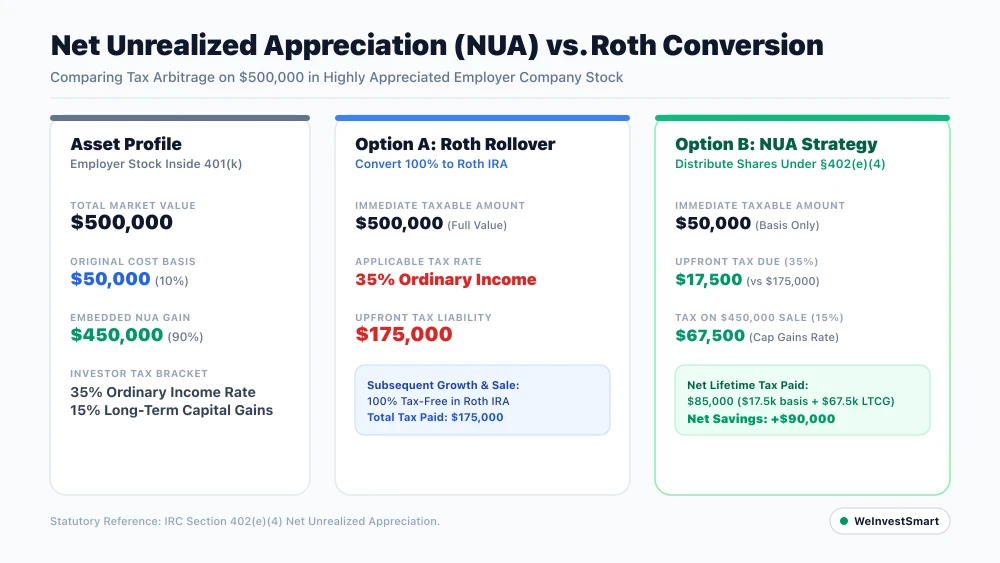
The difference between cost basis and market value determines whether NUA outperforms a Roth rollover. Consider an executive retiring at age 62 with $500,000 of employer stock in her 401(k) that has a cost basis of $50,000.
| Transaction Metric | Standard Pre-Tax IRA Rollover | Full Roth Conversion | NUA Distribution to Brokerage |
|---|---|---|---|
| Immediate Taxable Income | $0 at transfer | $500,000 ordinary income | $50,000 ordinary income (cost basis) |
| Immediate Tax Due (35% Bracket) | $0 | $175,000 | $17,500 |
| Tax on $450,000 Growth Upon Sale | 35% ordinary income ($157,500) | $0 (tax-free in Roth) | 15% to 20% capital gains ($67,500 to $90,000) |
| Net Total Tax Paid | $157,500 ordinary income | $175,000 upfront ordinary tax | $85,000 to $107,500 total tax |
| Net Savings vs. Roth Conversion | Baseline comparison | -$17,500 higher tax | +$67,500 to +$90,000 lower tax |
To qualify for NUA treatment, your distribution must meet four strict statutory criteria:
- Lump-Sum Distribution: You must distribute your entire account balance within a single calendar year across all qualified plans sponsored by that employer.
- Triggering Event: The distribution must occur following separation from service, attainment of age 59½, permanent disability, or death.
- In-Kind Stock Transfer: The employer shares must be transferred directly as shares into a taxable account without being liquidated to cash.
- Plan Sponsor Stock: The shares must represent securities of the corporate employer sponsoring the retirement plan.
If your employer stock has minimal appreciation or a high cost basis relative to current market value, rolling the shares into a Roth or traditional IRA remains mathematically superior. When embedded gains represent 70% or more of the total share value, NUA provides powerful tax savings.
Multi-Year Roth Conversion Case Study: Worked Dollar Math Across Tax Brackets
Executing systematic partial Roth conversions during transitional low-income years allows investors to fill favorable marginal tax brackets (such as the 22% and 24% brackets) before mandatory required minimum distributions (RMDs) push income into higher brackets later in life.
Rather than executing a single massive conversion that pushes income into the highest 35% or 37% tax brackets, affluent households use multi-year conversion brackets. This strategy is especially effective during the retirement transition window between career departure and the onset of Social Security benefits and required distributions at age 73 or 75.
Case Profile: David and Sarah’s Retirement Transition
David and Sarah are both 61 years old. They recently retired from corporate careers and plan to delay claiming Social Security until age 70 to maximize their guaranteed inflation-adjusted benefits.
- Current Portfolio: $850,000 in traditional pre-tax 401(k) and rollover IRA accounts, plus $300,000 in a taxable brokerage account.
- Annual Living Expenses: $90,000 per year, funded from cash reserves and taxable brokerage dividends.
- Current Taxable Baseline Income: $28,000 per year (dividends and interest).
- Projected Pre-Tax Balance at Age 75 Without Conversions: $1,800,000 (assuming 6% net annual compound growth).
- Mandatory Year 1 RMD at Age 75: Roughly $73,200 per year, layered on top of $78,000 in combined Social Security benefits.
Without planning, David and Sarah face a tax cliff at age 75. Their baseline income, RMDs, and taxable Social Security will push them into the 24% or 32% marginal brackets, while triggering substantial Medicare Part B and Part D Income-Related Monthly Adjustment Amounts (IRMAA).
The Multi-Year Bracket Filling Solution
David and Sarah implement a systematic 6-year partial Roth conversion strategy between age 62 and age 67. They choose to convert exactly enough pre-tax assets each year to fill the married filing jointly 24% federal tax bracket up to the top threshold of $400,000, while avoiding higher Medicare surcharges.
The table below illustrates their conversion schedule and tax outcomes:
| Year | Age | Baseline Taxable Income | Partial Roth Conversion | Total Taxable Income | Federal Marginal Rate | Estimated Tax on Conversion | Cumulative Converted |
|---|---|---|---|---|---|---|---|
| Year 1 | 62 | $28,000 | $120,000 | $148,000 | 22% | $24,200 | $120,000 |
| Year 2 | 63 | $29,000 | $125,000 | $154,000 | 22% | $25,300 | $245,000 |
| Year 3 | 64 | $30,000 | $130,000 | $160,000 | 22% | $26,500 | $375,000 |
| Year 4 | 65 | $31,000 | $135,000 | $166,000 | 22% | $27,700 | $510,000 |
| Year 5 | 66 | $32,000 | $140,000 | $172,000 | 22% | $28,900 | $650,000 |
| Year 6 | 67 | $33,000 | $145,000 | $178,000 | 22% | $30,100 | $795,000 |
| Totals | - | - | $795,000 | - | - | $162,700 | $795,000 |
By converting $795,000 across six controlled tax years, David and Sarah pay an average effective tax rate of approximately 20.5% on their converted funds. They pay all conversion taxes using cash from their taxable brokerage account, preserving every dollar inside the Roth account for compound growth.
By age 75, their remaining pre-tax balance is small enough that mandatory RMDs generate less than $18,000 per year. Their total taxable income remains safely beneath the Medicare IRMAA surcharge cliff, saving them an estimated $142,000 in lifetime taxes and healthcare surcharges.
To model your own conversion schedule and project compound balance growth across different timelines, evaluate your savings targets with our Roth IRA Calculator.
Five Essential Guardrails Before Executing an Advanced Conversion
Before completing any advanced Roth maneuver, you must verify account ownership rules, observe the statutory 5-year holding periods, establish an independent cash reserve for tax withholding, and evaluate prospective state-level income tax rates.
Advanced conversion strategies provide compelling tax advantages, but errors can trigger irreversible penalties or unexpected tax bills. Similarly, when managing non-spouse inheritances under the SECURE Act, follow the bracket-smoothing principles in our Inherited IRA 10-year rule guide to prevent mandatory distributions from triggering sudden tax bracket spikes. Keep these five principles in mind when executing your rollover plan:
1. Observe the Two Distinct 5-Year Rules
The IRS enforces two separate 5-year rules that govern Roth IRAs. The first rule governs qualified tax-free distributions of earnings, requiring that five tax years elapse from January 1 of the year you made your first contribution to any Roth IRA.
The second rule applies specifically to conversions. Each individual conversion has its own separate 5-year holding clock. If you withdraw converted principal before completing five tax years and you are under age 59½, the distribution incurs a 10% early withdrawal penalty under IRC Section 72(t).
2. Never Withhold Taxes Directly From the Conversion
When completing a Roth conversion, custodians will ask if you want federal and state taxes withheld from the transaction. You should decline withholding.
If you are under age 59½, any dollars withheld for taxes are classified as an early distribution, subjecting those funds to regular income tax plus a 10% penalty. Always pay conversion taxes from external taxable cash reserves so that 100% of your converted balance enters the Roth account.
3. Maintain Clear Spousal IRA Boundaries
The IRS aggregation rule applies to individuals, not married couples. If your spouse holds a large pre-tax traditional IRA balance, that balance has no effect on your ability to execute a clean backdoor Roth IRA conversion.
As long as your own personal traditional, SEP, and SIMPLE IRA balances equal zero on December 31, your conversion remains 100% tax-free regardless of your spouse’s holdings.
4. Account for State Income Tax Timing
Federal tax rates are uniform, but state income tax rates vary from 0% in states like Florida, Texas, and Washington to over 13% in California. If you plan to relocate to a low-tax or zero-tax state in retirement, delaying major taxable Roth conversions until after establishing legal residency can yield substantial tax savings.
5. Monitor Medicare IRMAA Lookback Windows
Medicare Part B and Part D premiums are adjusted based on your modified adjusted gross income from two years prior. A large Roth conversion executed at age 63 can trigger higher Medicare premiums when you enroll at age 65. Structure your multi-year conversion schedule to stay below IRMAA thresholds whenever possible.
Frequently Asked Questions
Can high earners still contribute to a Roth IRA?
Yes. While direct Roth IRA contributions are phased out for high earners, you can utilize the Backdoor Roth strategy by making a nondeductible contribution to a traditional IRA and promptly converting it to a Roth IRA.
How does the IRS pro-rata rule affect Roth conversions?
Under IRC Section 408(d)(2), the IRS calculates the taxable portion of a conversion based on the ratio of pre-tax to after-tax dollars across all your traditional, SEP, and SIMPLE IRAs as of December 31, preventing you from converting only after-tax contributions tax-free.
How does a 401(k) reverse rollover eliminate pro-rata taxes?
By rolling pre-tax IRA assets into an active 401(k) plan before December 31, you reduce your total non-Roth IRA balance to zero because employer plans are excluded from IRA aggregation, allowing subsequent nondeductible conversions to occur with zero taxable gain.
What plan rules are required to execute a Mega Backdoor Roth?
Your employer 401(k) plan must explicitly permit voluntary after-tax contributions beyond standard elective deferrals and offer either automated in-plan Roth conversions or in-service non-hardship distributions to a Roth IRA.
When should you choose Net Unrealized Appreciation (NUA) over a Roth conversion?
NUA is mathematically superior when your employer company stock has a very low cost basis and substantial embedded growth, allowing you to pay long-term capital gains rates (up to 20%) upon sale rather than paying ordinary income tax rates (up to 37%) on a full Roth conversion.
How do Roth conversions interact with Medicare IRMAA surcharges?
Because the Social Security Administration uses a two-year lookback tax return, a large Roth conversion at age 63 or older increases your Modified AGI and can trigger tier surcharges. For full bracket thresholds and appeal rules, read our comprehensive guide to Medicare IRMAA surcharges and Form SSA-44 appeals.
This article is for educational purposes only and should not be considered personalized financial advice. Consider consulting with a financial advisor for guidance specific to your situation.
For educational purposes. Consider your own circumstances before making financial decisions. Read our editorial policy.
From reading to planning
Explore the numbers for yourself.
Use our free calculators to compare scenarios and understand your options.