Sole Proprietorship vs. LLC vs. S-Corp: Entity Guide
Understand legal and tax differences between a sole proprietorship, limited liability company (LLC), and S-Corporation tax election for small businesses.
When pursuing business ideas with low investment, launching an independent venture often begins with exciting client projects and incoming revenue. Many entrepreneurs focus intensely on customer acquisition, neglecting to choose a formal legal framework for their enterprise.
Operating without formal entity registration defaults your business into an unshielded legal status. Understanding how entity structures dictate legal liability, administrative overhead, and tax obligations is essential for building a resilient enterprise.
Key Takeaways
- Operating as a sole proprietor exposes your personal bank accounts, home, and vehicle to business lawsuits and debts.
- A Limited Liability Company creates a legal corporate veil that separates business liabilities from personal net worth.
- An S-Corporation is an IRS tax classification that enables profitable LLCs to reduce self-employment taxes.
- Electing S-Corp status typically becomes financially advantageous when net business profits consistently exceed $60,000 to $80,000 annually.
The Default Danger Zone: Unlimited Liability in a Sole Proprietorship
Whenever an individual begins freelancing, selling physical goods, or providing commercial services without state registration, the law automatically designates them as a sole proprietor. It represents the path of least resistance, requiring zero state filings or setup expenditures.
However, this initial simplicity conceals severe balance sheet risk. In a sole proprietorship, there is zero legal distinction between the individual owner and the commercial enterprise.
If a customer slips on your property, a client sues for professional errors, or a vendor contract defaults, creditors can pursue your personal home, checking accounts, and family assets. Understanding W-2 employee versus 1099 contractor status reinforces why informal working arrangements carry full entrepreneurial liability.
From a tax perspective, a sole proprietorship flows directly onto Schedule C of Form 1040. Every dollar of net commercial profit faces ordinary federal and state income tax plus the mandatory 15.3% self-employment tax.
According to research published by the Small Business Administration guide to business legal structures, over 86% of non-employer firms operate as informal sole proprietorships. This widespread lack of formal organization leaves millions of family balance sheets exposed to unhedged legal liabilities.
Building the Corporate Veil: Asset Protection with a Limited Liability Company
Forming a Limited Liability Company (LLC) establishes a formal legal boundary between your commercial operations and your private wealth. Registered through your home state, an LLC creates a distinct legal entity capable of entering contracts, holding assets, and incurring debt.
This structural separation is commonly known in jurisprudence as the corporate veil. If an LLC faces catastrophic litigation or commercial insolvency, legal claims attach strictly to company assets rather than your personal real estate and retirement funds.
To preserve this legal barrier, business owners must practice disciplined administration. Rigorously separating business and personal finances through dedicated business checking accounts and credit cards prevents opposing attorneys from piercing the corporate veil in court.
By default, the IRS taxes a single-member LLC as a “disregarded entity.” The owner enjoys robust state-level liability protection while maintaining simple pass-through tax reporting on Schedule C, paying standard self-employment taxes on net operating profits.
For the vast majority of freelancers, digital agencies, and independent consultants, the single-member LLC serves as the ideal foundational business home.
The Tax Optimization Move: How an LLC Elects S-Corporation Status
As business revenue and profitability expand, paying 15.3% self-employment tax on every dollar of net profit creates an unnecessary financial drag. At this inflection point, business owners can deploy an S-Corporation tax election:
Annual S-Corp Tax Savings = (Net Business Profit - W-2 Reasonable Salary) × 15.3% - Corporate Overhead
S-Corp Breakeven Profit = W-2 Reasonable Salary + (Annual Administrative Costs ÷ 15.3%)
An S-Corporation is not an independent business entity formed with state authorities. It represents an elective federal tax classification authorized under Subchapter S of the Internal Revenue Code.
An established LLC elects S-Corp tax treatment by filing IRS Form 2553 election guidelines with the Internal Revenue Service. Once approved, the business remains an LLC under state law while shifting to corporate tax rules for federal reporting.
The core financial advantage of an S-Corp election lies in splitting business earnings into two distinct categories:
- W-2 Reasonable Salary: The shareholder-employee must draw a defensible market wage subject to standard payroll taxes (FICA and Medicare).
- Shareholder Profit Distributions: Remaining corporate net profits can be withdrawn as dividends, which are completely exempt from the 15.3% self-employment tax.
This dual distribution mechanism allows profitable business owners to legally shield thousands of dollars from payroll taxes each calendar year.
Model Your Corporate Savings: Run your profit figures through our Self-Employment Tax Calculator to project your payroll tax burden, or plan estimated quarterly vouchers with our Quarterly Estimated Tax Calculator.
At-A-Glance: Comparing Business Structures Side-by-Side
The following comparison contrasts the three primary small business frameworks across liability protection, tax treatment, administrative complexity, and profitability thresholds:
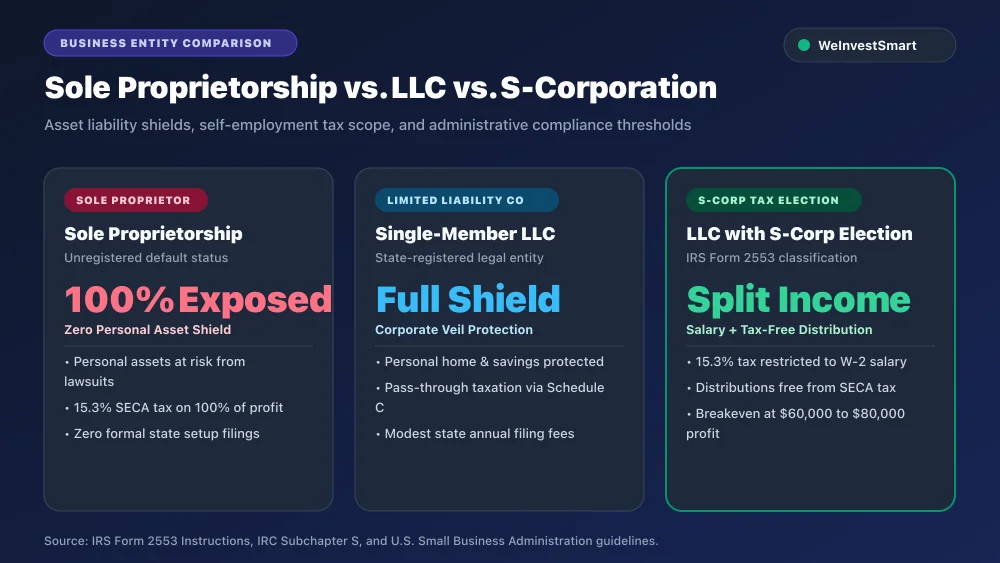
| Structural Feature | Sole Proprietorship | Limited Liability Company (LLC) | LLC Electing S-Corp Taxation |
|---|---|---|---|
| Personal Liability Shield | None (Personal assets exposed) | Complete (Protects personal assets) | Complete (Full corporate shield) |
| Federal Tax Status | Pass-Through (Schedule C) | Disregarded Entity (Pass-Through) | Corporate Pass-Through (Form 1120-S) |
| Self-Employment Tax Scope | 100% of Net Operating Profit | 100% of Net Operating Profit | Paid exclusively on W-2 Salary |
| Payroll Requirement | None | None (Owner Draws) | Mandatory Formal Payroll System |
| Annual Administrative Cost | $0 (Minimal filing fees) | $50 to $800 state annual reports | $1,500 to $3,000 for CPA and payroll |
| Recommended Net Profit Level | Under $30,000 testing phase | $30,000 to $70,000 | Consistently above $70,000 |
Case Study: How Carlos Saved $4,885 in Taxes by Electing S-Corp Status
Carlos, a 36-year-old marketing consultant, generated $110,000 in net profit after deducting business travel, software subscriptions, and home office expenses.
Operating as a standard single-member LLC, Carlos faced a self-employment tax burden of approximately $15,540 (accounting for the 92.35% taxable earnings multiplier) in addition to federal income taxes.
After consulting with a certified public accountant, Carlos submitted IRS Form 2553 to elect S-Corp tax status. Based on regional wage surveys for marketing specialists, Carlos established a defensible W-2 reasonable salary of $65,000, leaving $45,000 in corporate profit to be distributed as shareholder dividends.
Evaluating his paycheck with an interactive gross-to-net salary calculator allowed Carlos to calculate his payroll withholding accurately:
- Payroll Taxes on W-2 Salary: $65,000 multiplied by 15.3% FICA equals $9,945.
- Taxes on Shareholder Distribution: The remaining $45,000 incurred zero self-employment taxes, saving $6,885 in payroll tax liability.
- Administrative Overhead: Running formal payroll and filing Form 1120-S cost Carlos $2,000 in annual software subscriptions and CPA fees.
- Net Annual Bottom-Line Savings: $6,885 in tax savings minus $2,000 in overhead equaled $4,885 in net cash savings.
By implementing an S-Corp election, Carlos retained an extra $4,885 annually to invest directly into his retirement portfolio. Small business owners looking to shelter self-employment earnings can evaluate SEP IRA versus Solo 401(k) plans to maximize tax-deductible contributions.
IRS Reasonable Salary Rules: Avoiding Costly Audit Traps
The potential tax savings of an S-Corporation frequently tempt aggressive business owners to set artificially depressed W-2 salaries. Paying yourself a $15,000 salary while taking $100,000 in distributions represents an immediate audit trigger for the IRS.
Under official IRS S Corporation compensation and reasonable wage requirements, shareholder-employees must be paid fair market compensation for all services performed. The IRS possesses statutory authority to reclassify distributions as wages, assessing back payroll taxes, substantial penalties, and interest.
Establishing a defensible salary requires documenting objective criteria:
- The duties, operational hours, and complexity of tasks performed by the owner.
- Comparable salary data from commercial compensation databases and the Bureau of Labor Statistics.
- The business’s capital investment and gross revenue generation.
- Historical compensation patterns in comparable industry enterprises.
Maintaining written documentation justifying your salary calculation protects your business during routine corporate tax audits.
Operating Formalities: Preserving Legal Protections and Tax Compliance
Maintaining an active entity requires adhering to ongoing state and federal administrative formalities. Failing to observe corporate hygiene allows creditors to challenge your limited liability status in court.
Single-member LLCs should draft a written operating agreement outlining ownership percentages, decision-making protocols, and dissolution procedures. Even if state statutes do not require filing the operating agreement publicly, possessing an executed document substantiates your entity’s legitimacy.
Additionally, businesses must register an official registered agent in their state of incorporation and submit timely annual reports and franchise taxes. Missing annual state filings causes entities to fall into administrative forfeiture, dissolving your liability shield automatically.
Establishing disciplined habits for managing business cash flow ensures that tax reserves and payroll disbursements are funded smoothly without creating working capital stress. Separate bookkeeping prevents commingling personal and business funds.
Section 199A Qualified Business Income (QBI) Deduction Interactions
When evaluating S-Corporation tax savings, business owners must account for the Section 199A Qualified Business Income (QBI) deduction enacted under the tax code. The QBI deduction permits eligible pass-through entities to deduct up to 20% of their qualified business income.
The interaction between your W-2 reasonable salary and QBI introduces an important tax trade-off:
- Shareholder profit distributions qualify as qualified business income eligible for the 20% deduction.
- W-2 wages paid to the shareholder-employee do not qualify as QBI, reducing the pool of net business profit eligible for the 20% write-off.
However, for business owners with taxable income exceeding statutory phase-out limits ($197,300 for single filers and $394,600 for married couples filing jointly), the QBI deduction becomes subject to a wage limit test. At higher income levels, your QBI deduction is capped at the greater of 50% of W-2 wages paid by the business, or 25% of W-2 wages plus 2.5% of the unadjusted basis of qualified depreciable property.
In this high-income bracket, paying yourself zero W-2 salary as a sole proprietor or disregarded LLC could eliminate your Section 199A deduction entirely if your income exceeds the threshold. Electing S-Corp status and paying a substantial W-2 salary unlocks the 50% wage cap, preserving tens of thousands of dollars in QBI deductions.
Election Deadlines and Relief Under Revenue Procedure 2013-30
IRS Form 2553 must be submitted to the IRS no later than two months and fifteen days (75 days) after the start of the tax year in which the election is to take effect, or at any time during the preceding tax year. For a calendar-year LLC, the annual deadline is March 15.
If you miss the March 15 deadline, you may still qualify for retroactive relief under IRS Revenue Procedure 2013-30. To qualify for late election relief, the business must demonstrate reasonable cause for failing to file on time, have intended to be classified as an S-Corporation as of the effective date, and report all income consistently on Form 1120-S.
Entrepreneurs seeking to reduce their net tax liability should also examine strategies for lowering taxable income to ensure they capture all above-the-line and pass-through deduction allowances.
Strategic Roadmap: Deciding When to Evolve Your Business Structure
Choosing the appropriate business structure represents an ongoing progression rather than a single permanent decision. Your legal and tax architecture should adapt as your revenue and client commitments mature:
- Testing Phase ($0 to $30,000 Profit): When testing a preliminary side hustle, operating as a sole proprietor keeps initial startup friction low.
- Growth Phase ($30,000 to $70,000 Profit): As soon as you sign paying corporate clients or perform work involving liability risk, immediately register a single-member LLC to establish your corporate veil.
- Scale Phase ($70,000+ Profit): Once consistent profitability is achieved and your net earnings exceed your reasonable market salary by at least $20,000, file Form 2553 to elect S-Corporation tax treatment.
Mastering your pricing strategy by pricing your services profitably accelerates your path toward the profitability threshold where an S-Corp election becomes advantageous. Regularly consulting with professional legal and tax advisors ensures that your enterprise structure supports your long-term wealth goals.
Frequently Asked Questions About Business Structures
What is the main difference between a sole proprietorship and an LLC?
The primary distinction is personal asset protection through a formal legal shield. A sole proprietorship offers zero legal separation between business debts and personal assets, whereas a Limited Liability Company forms a separate legal entity that shields personal homes, savings, and vehicles from commercial liabilities.
Can a Limited Liability Company be taxed as an S-Corporation?
Yes, an S-Corporation represents an IRS tax status rather than an independent legal structure. A qualifying Limited Liability Company can elect S-Corporation taxation by submitting Form 2553 to the IRS, retaining state legal protections while dividing profits between salary and distributions.
At what profit level does an S-Corporation election make financial sense?
Most certified public accountants recommend evaluating an S-Corp election once annual net business profits consistently exceed sixty thousand to eighty thousand dollars. Below that financial threshold, annual payroll administrative fees, software costs, and corporate tax return preparation expenses generally outweigh any self-employment tax savings.
How does an S-Corporation reduce self-employment taxes?
An S-Corporation allows the business owner to divide net commercial profits into a W-2 reasonable salary and shareholder distributions. While the W-2 salary is subject to standard 15.3% payroll taxes, distributions remain completely exempt from self-employment taxes.
What is considered a reasonable salary for an S-Corp owner?
The IRS mandates that working shareholder-employees receive fair market compensation comparable to what an independent enterprise would pay for equivalent professional duties. Determining a defensible salary requires documenting industry wage surveys, specialized credentials, actual weekly operational hours, and geographic benchmarks.
This article is for educational purposes only and should not be considered personalized financial advice. Consider consulting with an attorney or certified public accountant (CPA) for guidance specific to your situation.

For educational purposes. Consider your own circumstances before making financial decisions. Read our editorial policy.
From reading to planning
Explore the numbers for yourself.
Use our free calculators to compare scenarios and understand your options.