How to Lower Your Taxable Income (Legally): A Guide to Tax Credits and Deductions
Lower your taxable income legally with deductions and credits. Master above-the-line adjustments, standard deduction limits, and refundable tax credits.

Most taxpayers treat annual tax filing with a sense of dread and resignation, assuming their tax liability is a fixed, non-negotiable consequence of their salary. In reality, the Internal Revenue Code functions as an economic incentive system designed to reward specific saving, investing, healthcare, and educational choices.
Understanding how to navigate between tax deductions and tax credits transforms you from a passive filer into a strategic financial planner. Applying these statutory mechanisms enables you to legally lower your taxable base and retain more of your income.
Key Takeaways
- Tax deductions shorten your taxable income base before tax rates apply, with their value determined by your marginal tax bracket.
- Tax credits deliver a direct, dollar-for-dollar reduction of your final calculated tax liability, providing equal dollar savings across all income brackets.
- Above-the-line deductions on Schedule 1 lower your Adjusted Gross Income (AGI) directly, qualifying you for additional credits without needing to itemize.
- For the 2026 tax year, the standard deduction is $16,100 for single filers, $32,200 for married couples filing jointly, and $24,150 for heads of household.
The Financial Mechanics: Tax Deductions vs. Tax Credits
To optimize your tax return, you must first distinguish between the two primary mechanisms that reduce your federal liabilities: deductions and credits.
Adjusted Gross Income = Gross Income - Above-the-Line Deductions
Taxable Income = Adjusted Gross Income - (Standard Deduction OR Itemized Deductions)
Final Tax Bill = (Taxable Income × Marginal Tax Rate) - Tax Credits
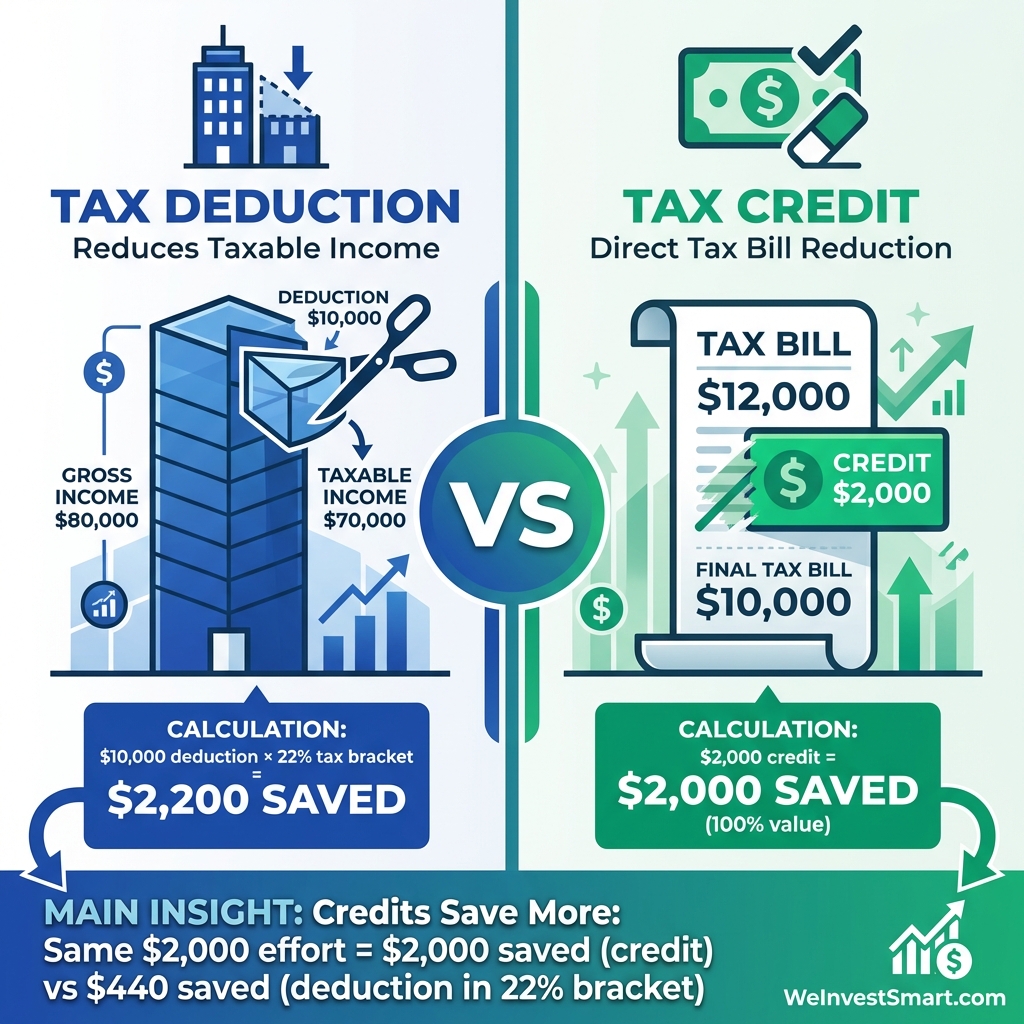
A tax deduction reduces your taxable income before the tax brackets apply. If your total income is $80,000 and you claim $10,000 in qualifying deductions, the IRS calculates your tax liability on $70,000. The actual cash value of a deduction depends on your marginal tax bracket. In the 22% tax bracket, a $10,000 deduction saves you $2,200 in federal taxes ($10,000 × 0.22).
A tax credit reduces your final calculated tax bill dollar-for-dollar. If your calculated tax liability is $12,000 and you qualify for a $2,000 tax credit, your final payment drops to $10,000. Unlike deductions, the value of a tax credit remains identical regardless of whether your marginal rate is 12%, 22%, or 35%.
Real Numbers: The Math of Deductions vs. Credits
Consider Sarah, a single filer earning an annual salary of $75,000. After applying her baseline standard deduction, her calculated federal income tax is $8,140 for the 2026 tax year. Sarah evaluates two competing tax moves:
- Scenario 1 (Deduction Focus): Sarah makes a $6,000 deductible contribution to a traditional IRA. In her 22% marginal tax bracket, this deduction reduces her tax liability by $1,320 ($6,000 × 0.22).
- Scenario 2 (Credit Focus): Sarah pays $4,000 in eligible tuition expenses for professional coursework, qualifying for the Lifetime Learning Credit worth $2,000 (20% of eligible expenses up to $10,000). This credit knocks $2,000 directly off her tax bill.
Despite allocating less cash in Scenario 2 ($4,000 versus $6,000), the credit strategy saves Sarah $680 more than the deduction ($2,000 versus $1,320). When combined strategically, claiming both the IRA contribution and the education credit reduces her final tax bill from $8,140 to $4,820, generating $3,320 in cumulative tax savings.
Understanding your marginal versus effective tax rate helps you evaluate whether pre-tax deductions or post-tax credits deliver superior returns for your income tier.
Model Your Deductions: Calculate your net take-home pay across federal tax brackets with our Gross-to-Net Paycheck Calculator, or see how pre-tax deductions shift your phase-out boundaries with our MAGI Calculator.
Above-the-Line Deductions: Lowering Your AGI Directly
Above-the-line deductions represent the most valuable adjustments in the federal tax code because you can claim them regardless of whether you choose the standard deduction or itemize on Schedule A. According to official IRS credits and deductions guidelines, these adjustments sit on IRS Form 1040 Schedule 1 and reduce your Adjusted Gross Income (AGI).
Lowering your AGI is critical because many valuable tax credits, itemized deduction thresholds, and healthcare subsidies phase out above specific AGI or Modified AGI (MAGI) limits:
1. Traditional IRA Contributions
Contributions to a traditional individual retirement account can provide an immediate tax deduction. For the 2026 tax year, qualifying individuals can contribute and deduct up to $7,000 ($8,000 if age 50 or older) under IRS Notice retirement contribution guidelines. If you or your spouse participate in an employer-sponsored retirement plan like a 401(k), the deductibility of your contribution phases out across statutory income ranges. If you execute backdoor conversions with nondeductible balances, follow the Backdoor Roth pro-rata rule and Form 8606 to avoid surprise taxes. Compare your options with our retirement accounts explained guide.
2. Health Savings Account (HSA) Contributions
Individuals covered under an eligible High-Deductible Health Plan (HDHP) can make 100% tax-deductible contributions to a Health Savings Account. Under IRS Revenue Procedure 2025-19, the 2026 contribution limit is $4,400 for self-only coverage and $8,750 for family coverage, with an additional $1,000 catch-up contribution permitted for account holders age 55 and older. HSAs provide a triple-tax advantage: contributions are tax-deductible, investment growth is tax-free, and distributions for qualified medical expenses are exempt from taxation.
3. Student Loan Interest Deduction
Qualifying borrowers can deduct up to $2,500 of interest paid on eligible higher education loans during the year under IRS Publication 970 Tax Benefits for Education. This deduction phases out for single filers with MAGI between $85,000 and $100,000 (and between $170,000 and $200,000 for married couples filing jointly).
4. Self-Employed Health Insurance and Retirement
Self-employed workers and independent contractors can deduct 100% of health, dental, and qualifying long-term care insurance premiums paid for themselves, their spouse, and dependents. Independent professionals can also fund tax-sheltered Solo 401(k) and SEP IRA retirement accounts, reducing both current taxable income and long-term retirement liabilities. If you earn contract revenue, reviewing our W-2 employee vs 1099 contractor guide explains self-employment tax deductions in detail.
5. State 529 Education Savings Deductions
While federal law does not provide an upfront deduction for 529 contributions, over 30 states provide state income tax deductions or credits for residents contributing to their home-state plan. Review the full spectrum of 529 plan tax advantages and state rules to capture immediate state deductions while investing for future education expenses.
Standard Deduction vs. Itemized Deductions: Which Path Wins?
When calculating your taxable income from AGI, the tax code requires you to choose between the standard deduction and itemized deductions. You cannot claim both in the same tax year, so filers should choose whichever method yields the larger total deduction.
Under IRS Revenue Procedure statutory inflation indexation, the standard deduction amounts for the 2026 tax year are:
- Single Filers: $16,100
- Married Filing Jointly: $32,200
- Head of Household: $24,150
- Additional Senior / Blind Deduction: $1,600 per qualifying individual ($2,000 if unmarried and not a surviving spouse).
When Does It Pay to Itemize on Schedule A?
Itemizing makes financial sense only when your cumulative eligible deductible expenses exceed your standard deduction allowance. The primary itemized deductions include:
- State and Local Tax (SALT) Deduction: Filers can deduct state and local income taxes (or general sales taxes) plus real estate and personal property taxes. Under statutory OBBBA provisions for 2025 to 2028, the SALT cap is adjusted to $40,400 for the 2026 tax year, phasing down by 30% of MAGI above $500,000 to a $10,000 floor.
- Mortgage Interest Deduction: Homeowners can deduct interest paid on up to $750,000 of qualifying home acquisition debt ($375,000 for married filing separately) on their primary residence and one designated second home.
- Charitable Contributions: Cash donations to public charities are deductible up to 60% of your AGI when itemizing. For non-itemizers, the tax code provides a separate above-the-line charitable deduction of up to $1,000 for single filers ($2,000 for joint returns). Review our common tax deductions guide for detailed documentation rules.
- Medical and Dental Expenses: Out-of-pocket medical and dental costs are deductible on Schedule A only to the extent that they exceed 7.5% of your AGI.
| Deductible Category | Single Filer Expense | Married Joint Filers | Itemizing Consideration |
|---|---|---|---|
| Baseline Standard Deduction (2026) | $16,100 | $32,200 | Benchmark hurdle to exceed |
| State and Local Taxes (SALT Cap) | $10,000 to $40,400 | $10,000 to $40,400 | Subject to income phaseout above $500k |
| Mortgage Interest ($500k loan at 6.5%) | ~$32,000 | ~$32,000 | High mortgage rates push filers over the hurdle |
| Charitable Contributions | $5,000 | $8,000 | Cash gifts require bank record or receipt |
| Example Total Itemized Deductions | $47,000 | $50,000 | Itemizing saves more than standard deduction |
Tax Credits: Maximizing Dollar-for-Dollar Reductions
Tax credits represent the most powerful savings tools in personal finance because they directly reduce your final calculated tax obligation.
Nonrefundable vs. Refundable Credits
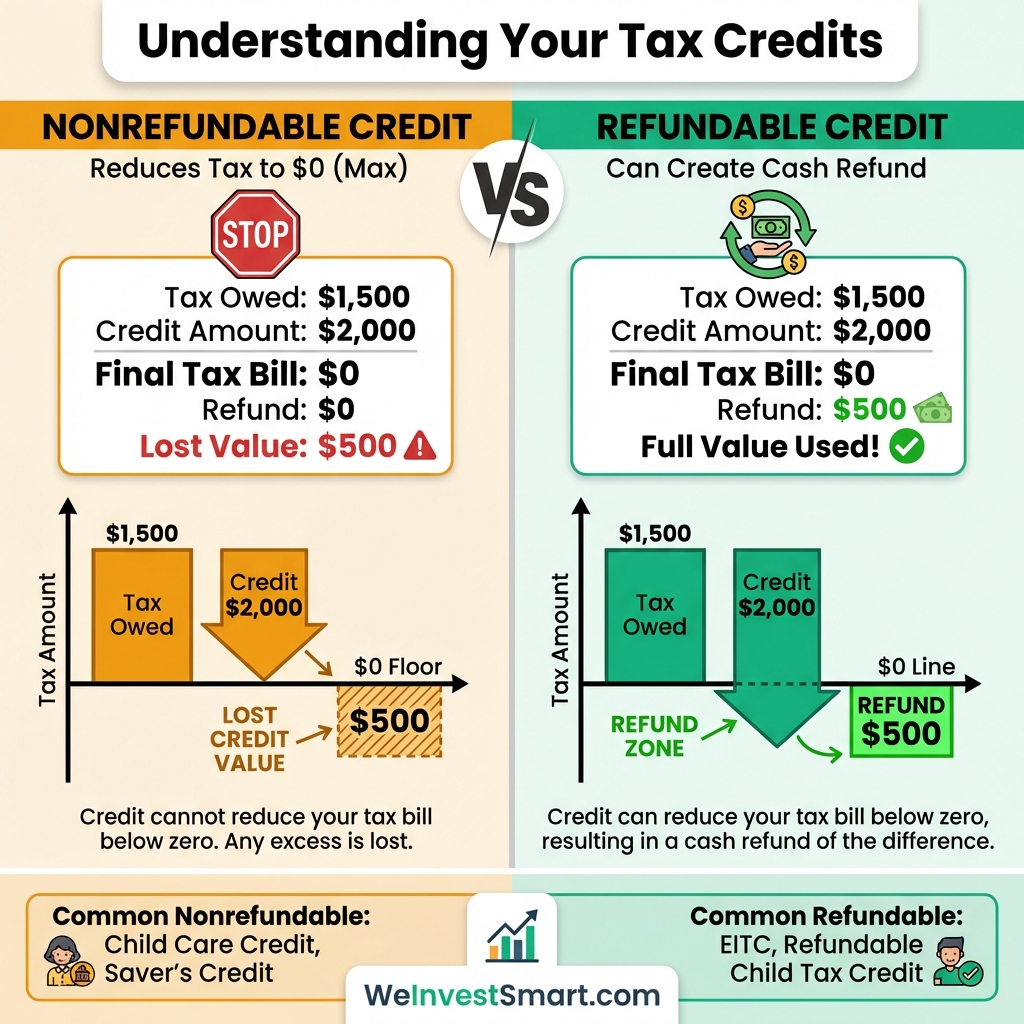
A nonrefundable tax credit can reduce your calculated tax liability down to zero, but any remaining credit amount is forfeited. If your calculated tax liability is $1,500 and you qualify for a $2,000 nonrefundable credit, your final tax bill becomes $0, but the excess $500 does not result in a refund check.
A refundable tax credit can reduce your tax liability below zero. If your calculated tax liability is $1,500 and you claim a $2,000 refundable credit, the IRS eliminates your $1,500 bill and sends you the remaining $500 as a cash refund.
High-Value Tax Credits to Review Before Filing
- Child Tax Credit (CTC): Provides up to $2,200 per qualifying child under age 17, with a refundable portion (the Additional Child Tax Credit) available to lower-income families. The credit phases out for single parents with MAGI above $200,000 ($400,000 for married couples filing jointly).
- Earned Income Tax Credit (EITC): A refundable credit engineered for low- to moderate-income workers. Depending on filing status and number of qualifying dependents, the maximum EITC exceeds $8,000.
- American Opportunity Tax Credit (AOTC): Available for the first four years of post-secondary higher education, the AOTC is worth up to $2,500 per eligible student. Up to 40% of the credit ($1,000) is refundable.
- Child and Dependent Care Credit: Offsets expenses paid for daycare, babysitters, or elder care so you can work or look for work. Filers can claim a percentage of up to $3,000 in qualifying expenses for one dependent or $6,000 for two or more dependents.
- Retirement Savings Contributions Credit (Saver’s Credit): Provides a credit of 10%, 20%, or 50% on up to $2,000 of retirement contributions ($4,000 MFJ) for lower-income taxpayers saving in a 401(k) or IRA.

Strategic Action Plan: Year-End Steps to Reduce Your Tax Bill
Implementing proactive tax planning before the December 31 calendar deadline unlocks compounding savings across subsequent tax years:
- Max Out Employer-Sponsored Pre-Tax Accounts: Increase payroll deferrals to your workplace 401(k) or 403(b) plan. Elective deferrals lower Box 1 taxable wages on your W-2 dollar-for-dollar.
- Fund Your Health Savings Account: Maximize contributions to your HSA before the tax-filing deadline (typically April 15) to capture an immediate above-the-line deduction.
- Audit Potential Itemized Write-Offs: If you have high mortgage interest, significant property taxes, or medical expenses exceeding 7.5% of AGI, evaluate whether bunching charitable contributions into alternating tax years pushes you over the standard deduction threshold.
- Harvest Capital Losses: Offset capital gains and up to $3,000 of ordinary wage income by selling declining assets in taxable brokerage accounts before year-end.
- Verify Eligibility for Federal Credits: Confirm your phase-out boundaries for the Child Tax Credit, Saver’s Credit, and education credits using our Net Income Calculator to project your final after-tax cash reserves.
- Maintain Contemporaneous Tax Records: Retain Form 1098-E student loan interest statements, Form 1098 mortgage interest disclosures, property tax receipts, and charitable donation acknowledgments in a secure digital folder. The IRS requires contemporaneous written records for any single charitable contribution of $250 or more.
Frequently Asked Questions About Lowering Taxable Income
What is the difference between a tax credit and a tax deduction?
A tax deduction lowers your taxable income, reducing the amount of earnings subject to taxation based on your marginal tax rate. A tax credit provides a direct, dollar-for-dollar reduction of your final calculated tax liability. For example, a $1,000 credit reduces your taxes owed by exactly $1,000.
Which is better, a tax credit or a tax deduction?
A tax credit is generally more valuable than an equal-dollar deduction because it reduces your tax liability dollar-for-dollar. A $1,000 deduction saves $220 for someone in the 22% tax bracket, whereas a $1,000 credit saves $1,000 for any qualifying taxpayer.
What is a refundable tax credit?
A refundable tax credit can reduce your federal tax bill below zero, resulting in a cash refund check for the difference. If you owe $500 in federal tax and claim a $1,200 refundable credit, the IRS issues a $700 refund payment. Nonrefundable credits can only reduce your tax bill to zero.
Can I claim tax deductions if I do not itemize?
Yes, above-the-line deductions on Form 1040 Schedule 1 can be claimed even if you take the standard deduction. These include contributions to health savings accounts (HSAs), traditional IRAs, student loan interest payments, and self-employed health insurance premiums.
How do I claim tax credits and deductions on my tax return?
You claim deductions and credits on your annual Form 1040 tax return. Above-the-line deductions are reported on Schedule 1, itemized deductions are calculated on Schedule A, and specific tax credits require dedicated schedules such as Schedule 8812 for the Child Tax Credit or Form 8863 for education credits.
This article is for educational purposes only and should not be considered personalized tax advice. Consider consulting with a certified public accountant (CPA) or enrolled agent (EA) for guidance specific to your financial situation.

For educational purposes. Consider your own circumstances before making financial decisions. Read our editorial policy.
From reading to planning
Explore the numbers for yourself.
Use our free calculators to compare scenarios and understand your options.