W-2 Employee vs 1099 Contractor: Taxes, Pay & Rules
W-2 vs 1099: see why a $105,000 contract can net less than an $85,000 salary, how 15.3% SECA tax works, and how to calculate break-even billing rates.
Entering freelancing or independent consulting fundamentally transforms your relationship with the federal tax code. Receiving full, unwithheld revenue checks feels lucrative initially, but unmanaged tax obligations can quickly produce significant IRS liabilities.
Understanding whether you operate as a statutory W-2 employee or an independent 1099 contractor dictates your net income, deductible write-offs, and legal protections. Evaluating these differences ensures you price contracts accurately and retain more of your earnings.
Key Takeaways
- W-2 employees have federal, state, and payroll taxes withheld automatically, while 1099 contractors operate as independent business owners responsible for self-employment taxes.
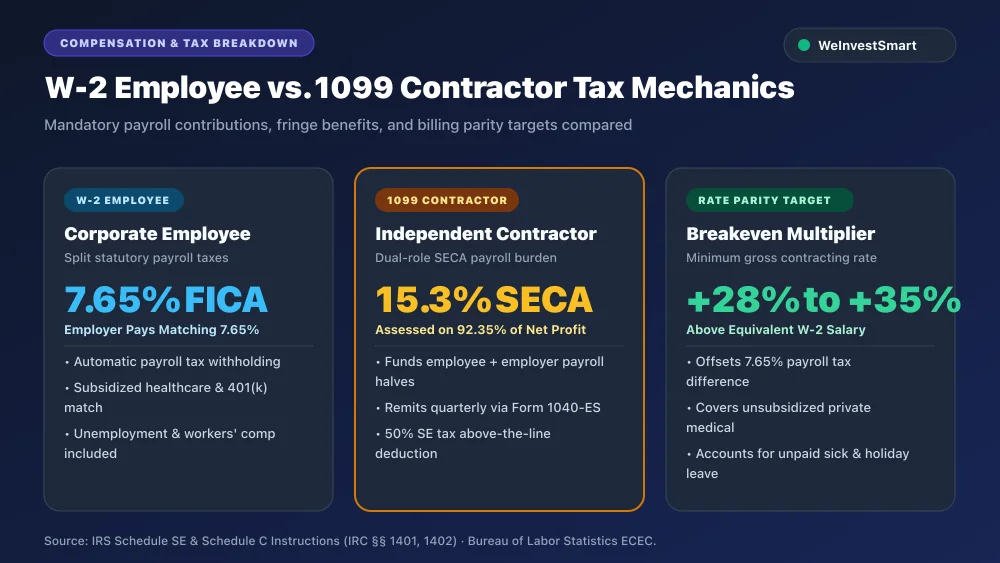
- Independent contractors pay the full 15.3% SECA tax covering both employer and employee portions of Social Security and Medicare on 92.35% of net profit.
- 1099 workers write off ordinary and necessary business operating expenses on IRS Schedule C, directly lowering taxable profit and self-employment tax.
- Because employer fringe benefits average 29.6% of civilian compensation, independent contractors must charge 28% to 35% higher gross rates to achieve true financial parity.
What Is the Difference Between a W-2 Employee and a 1099 Contractor?
The core difference between a W-2 employee and a 1099 contractor centers on legal control and tax liability. An employer directs when, where, and how a W-2 employee performs work and withholds payroll taxes each pay period. A 1099 contractor operates an independent trade, controls project execution methods, and remits all income and payroll taxes independently.
The distinction between these classifications stems from statutory labor laws and federal tax regulations. When pricing your services as an independent consultant, failing to account for missing employer subsidies creates immediate financial shortfalls.
The Internal Revenue Service worker classification guidelines evaluate working arrangements across three operational pillars:
Behavioral Control
Behavioral control examines whether the hiring company retains the legal right to direct and control how the worker does the task. If a company enforces mandatory shift hours, provides standardized equipment, and dictates step-by-step procedures, the law typically views the worker as an employee. True independent contractors deliver specified project outcomes using their own equipment, software, and autonomous methods.
Financial Control
Financial control analyzes whether the business aspects of the worker’s job are controlled by the payer. Independent contractors invest substantial personal capital into facilities, software licenses, and professional equipment. They remain free to market their services to competing clients and realize a genuine opportunity for business profit or loss. Employees, by contrast, receive guaranteed regular wages and have necessary business tools furnished by the firm.
Type of Relationship
Relationship factors evaluate written agreements, employee benefits, and project permanency. The U.S. Department of Labor worker misclassification standards reinforce that contractual labels do not override operational reality. When an ongoing working relationship provides paid time off, health insurance, or pension participation, or represents the core business output of the enterprise, the worker is legally an employee.
Note: Employers who intentionally misclassify standard employees as 1099 contractors to evade payroll taxes face severe federal penalties, retroactive payroll tax assessments, and mandatory reimbursement of unpaid overtime under the Fair Labor Standards Act.
How Does Self-Employment Tax Work for 1099 Contractors?
Self-employment tax is a mandatory federal assessment under the Self-Employment Contributions Act (SECA) that funds Social Security and Medicare. Unlike traditional W-2 employees who split payroll contributions evenly with their employer, independent contractors must fund both halves of the statutory payroll tax.
Under the Federal Insurance Contributions Act (FICA), a W-2 employee pays 7.65% from their gross earnings (6.2% Social Security plus 1.45% Medicare). The employer remits a matching 7.65% tax from company funds, bringing total contributions to 15.3%. Independent contractors fall under Internal Revenue Service self-employment tax regulations. Because contractors are legally both the employee and employer, they are responsible for the entire 15.3% statutory assessment.
The tax code applies this assessment to 92.35% of net business profit rather than gross invoice billings. This adjustment mirrors the deduction employers receive for paying payroll taxes:
SECA Liability = Net Business Profit × 92.35% × 15.3%
The 12.4% Social Security portion applies up to the statutory annual wage base cap ($184,500 for the 2026 tax year). The 2.9% Medicare component continues indefinitely on all net earnings without an income ceiling. Single filers earning net business profit above $200,000 (or $250,000 for married couples filing jointly) also incur an Additional Medicare Tax of 0.9%.
Under Internal Revenue Code Section 164(f), contractors receive an above-the-line deduction equal to 50% of their calculated self-employment tax on Form 1040 Schedule 1. This deduction lowers adjusted gross income (AGI) before applying standard or itemized deductions, softening the federal income tax burden.
| Self-Employment Tax Component | Accounting Benchmark |
|---|---|
| Gross Contracting Invoices | $100,000 |
| Deductible Schedule C Operating Expenses | -$20,000 |
| Net Taxable Business Profit | $80,000 |
| Statutory Taxable Base Factor | 92.35% |
| Adjusted Taxable SE Base ($80,000 × 0.9235) | $73,880 |
| Social Security Portion (12.4% on base under $184,500) | $9,161 |
| Medicare Portion (2.9% uncapped) | $2,143 |
| Total Mandatory SECA Tax Liability | $11,304 |
| Form 1040 Schedule 1 Above-the-Line Write-Off (50%) | $5,652 |
Model Your Net Income: Run your revenue through our Self-Employment Tax Calculator to project your exact Social Security and Medicare breakdown, or plan quarterly obligations with our Quarterly Estimated Tax Calculator.
W-2 Employee vs. 1099 Independent Contractor: Complete Comparison
Evaluating operational, legal, and financial differences side-by-side demonstrates why moving between employment models requires adjusting gross income targets:
| Feature & Obligation | W-2 Corporate Employee | 1099 Independent Contractor | Financial Planning Impact |
|---|---|---|---|
| Tax Withholding | Automatic federal, state, and FICA payroll deductions on each paycheck. | Zero withholding; contractor remits quarterly estimated payments via Form 1040-ES. | Contractors face cash flow discipline risks and strict underpayment penalty deadlines. |
| FICA / SECA Tax Rate | 7.65% paid by worker; matching 7.65% funded by employer. | Full 15.3% paid by contractor on 92.35% of net Schedule C profit. | Contractors shoulder an extra 7.65% payroll surcharge on equivalent base income. |
| Business Expense Deductions | None; miscellaneous unreimbursed employee expenses are disallowed. | Full deduction of ordinary and necessary business expenses on Schedule C. | Legitimate business write-offs directly reduce net profit and self-employment tax. |
| Health & Retirement Benefits | Subsidized health insurance, paid leave, and corporate 401(k) matching. | Zero company benefits; contractor funds private medical and retirement savings. | Fringe benefits represent roughly 30% of total employee compensation packages. |
| Operational Autonomy | Managed work hours, employer-assigned workspaces, and supervisor direction. | Complete control over work schedule, client volume, and project execution. | Contractors trade employment stability for flexible revenue and business scalability. |
When evaluating sole proprietorship vs LLC structures, contractors often find that formal business entities provide vital commercial liability protection as client operations scale.
Case Study: The Math of an $85,000 W-2 vs. a $105,000 1099 Offer
Reviewing a real-world compensation comparison reveals why higher top-line contracting numbers can be deceptive without careful tax and fringe benefit modeling.
Consider Elena, age 31, a software engineer choosing between two competing career offers:
- Offer A: A full-time W-2 corporate role paying an $85,000 annual salary with subsidized healthcare ($6,000 annual employer subsidy) and a 4% 401(k) matching contribution ($3,400).
- Offer B: A 1099 independent contracting retainer paying $105,000 annually with zero benefits.
At first glance, the $105,000 contractor offer appears to provide a $20,000 income boost. Elena calculates her actual net earnings to evaluate whether the contract provides genuine financial superiority:
| Financial Element | W-2 Employee ($85,000 Base) | 1099 Contractor ($105,000 Gross) |
|---|---|---|
| Gross Total Billings / Salary | $85,000 | $105,000 |
| Ordinary Business Expenses (Software, Laptop, Utilities) | $0 (Disallowed) | -$11,500 (Deductible on Schedule C) |
| Net Taxable Business Profit | N/A | $93,500 |
| FICA or SECA Payroll Tax | -$6,503 (7.65%) | -$13,212 (15.3% on 92.35% of net profit) |
| 50% SE Tax Above-the-Line Write-off | N/A | +$6,606 adjustment to AGI |
| Estimated Federal & State Income Tax | -$11,400 | -$12,850 |
| Out-of-Pocket Health Insurance | -$1,800 (Employee premium share) | -$7,800 (Full private ACA individual policy) |
| Employer 401(k) Match Forfeited | +$3,400 (Employer funded) | $0 (Self-funded only) |
| Net Realized Economic Value | $68,697 | $59,638 |
Despite generating $20,000 more in gross revenue, Elena nets nearly $9,000 less as an independent contractor once accounting for full payroll taxes, unsubsidized private health insurance, and missing employer retirement contributions. Understanding tax credits and deduction strategies demonstrates that Elena would need to negotiate a contractor rate of at least $118,000 to match her $85,000 W-2 package.
According to economic data published in Bureau of Labor Statistics employer compensation reports, employer-provided benefits account for 29.6% of total civilian compensation costs. Contractors must price this premium into their baseline billing rates.
How to Calculate Your Contractor Parity Rate
Calculating your minimum viable 1099 hourly or project rate requires pricing all business overhead and lost employee subsidies into your revenue target:
Contractor Parity Rate = (Base Salary + Fringe Benefit Value + Operating Expenses) ÷ Billable Hours
Independent contractors rarely bill 40 hours per week for 52 consecutive weeks. Accounting for client acquisition, administrative bookkeeping, proposal generation, and three weeks of combined sick and vacation time, most full-time contractors average roughly 1,500 billable hours annually.
- Quantify Lost Benefits: Add the market replacement cost of individual health insurance ($6,000 to $9,000), retirement matching ($3,000 to $5,000), and statutory payroll tax differences (7.65% of net profit).
- Tabulate Operating Overhead: Include computer equipment, professional licenses, accounting fees, commercial liability insurance, and web hosting ($8,000 to $15,000 annually).
- Divide by Billable Hours: Divide total target gross revenue by your projected annual billable hours (typically 1,500 hours) rather than theoretical 2,080 working hours.
Consulting our companion hourly to salary calculator helps you convert between annualized income figures and daily or hourly billing schedules.
Schedule C Deductions: How Contractors Offset Tax Liabilities
Independent contractors offset self-employment and income taxes by writing off ordinary and necessary business expenses on IRS Form 1040 Schedule C. Eligible deductions reduce your gross revenue dollar-for-dollar, shrinking both your self-employment tax bill and federal adjusted gross income.
Unlike standard W-2 workers who cannot deduct job-related costs, contractors can deduct a wide array of operational overhead. Tracking common tax deductions preserves substantial capital across the tax year:
Home Office Expenses
Contractors using a dedicated portion of their home regularly and exclusively for business can deduct a percentage of rent, mortgage interest, property taxes, and home utilities. The IRS offers either a simplified deduction of $5 per square foot (up to 300 square feet, yielding a maximum $1,500 deduction) or the actual expense method based on square footage ratios.
Professional Subscriptions, Software, and Equipment
Laptops, design software, bookkeeping applications, web hosting, and mobile phone bills dedicated to business operations are fully deductible business expenditures. Under Section 179 expensing rules, qualifying equipment purchased and placed in service during the tax year can often be written off entirely in year one.
Vehicle Mileage and Travel
Documented driving for client meetings, supply runs, and on-site consultations is deductible. Contractors can track actual vehicle maintenance and fuel costs or utilize the IRS standard mileage rate (72.5 cents per business mile for the 2026 tax year). Personal commuting miles from home to a primary office remain strictly non-deductible.
Professional Services and Insurance
Retaining legal counsel, hiring a CPA for tax preparation, and carrying errors and omissions or general commercial liability insurance qualify as standard operational write-offs on Schedule C.
The 1099 Financial Blueprint: Managing Cash Flow and Estimated Taxes
Operating successfully as an independent contractor requires implementing a structured cash reserve system. Establishing the following administrative habits prevents cash crunches:
1. The 30% Tax Isolation Rule
Every time a client invoice is paid, immediately transfer 25% to 30% of the funds into an isolated high-yield business savings account. Treat this capital as legally encumbered funds belonging to the IRS. You can project your post-tax take-home cash flow in our gross-to-net paycheck calculator, and log business driving write-offs with the Mileage Reimbursement Calculator.
2. Pay Quarterly Estimated Taxes on Schedule
Remit estimated payments using the Electronic Federal Tax Payment System (EFTPS) on the four statutory deadlines: April 15, June 15, September 15, and January 15. To satisfy IRS safe harbor rules and avoid underpayment penalties, remit either 100% of your prior year total tax liability (110% if your prior year AGI exceeded $150,000) or 90% of your current tax year obligation.
3. Establish Dedicated Small Business Retirement Accounts
Contractors can shelter substantial income using tax-advantaged Solo 401(k) and SEP IRA retirement accounts. A Solo 401(k) allows contractors to contribute both as an employee (elective deferrals up to standard limits) and as an employer (up to 20% of adjusted net business profit), shielding tens of thousands of dollars from current income taxation.
Frequently Asked Questions About W-2 vs 1099 Tax Status
What is the primary difference between a W-2 employee and a 1099 contractor?
The primary distinction centers on legal autonomy, operational oversight, and tax remittance obligations. Employers control how W-2 employees perform work and withhold taxes automatically, whereas 1099 independent contractors maintain business independence and remit all federal, state, and self-employment taxes directly.
How much money should a 1099 contractor set aside for taxes?
Independent contractors should set aside 25% to 30% of every gross client invoice in a dedicated tax savings reserve. This cushion covers the mandatory 15.3% self-employment tax alongside federal and state income tax liabilities.
Can 1099 independent contractors deduct business expenses?
Yes, independent contractors deduct ordinary and necessary business expenses on IRS Form 1040 Schedule C to lower their net business profit. Eligible write-offs include home office square footage, specialized software subscriptions, professional liability coverage, and business vehicle mileage.
How do 1099 contractors pay federal taxes throughout the year?
Independent contractors remit quarterly estimated tax vouchers using IRS Form 1040-ES or the online EFTPS portal if they expect to owe $1,000 or more annually. Deadlines fall on April 15, June 15, September 15, and January 15.
What should you do if an employer improperly classifies you as a 1099 contractor?
Workers who suspect improper classification can submit IRS Form SS-8 to request an official federal worker status determination. When the IRS reclassifies a worker as an employee, the hiring entity becomes liable for retroactive payroll taxes, unemployment insurance, and overtime restitution.
This article is for educational purposes only and should not be considered personalized financial advice. Consider consulting with a financial advisor for guidance specific to your situation.

For educational purposes. Consider your own circumstances before making financial decisions. Read our editorial policy.
From reading to planning
Explore the numbers for yourself.
Use our free calculators to compare scenarios and understand your options.