Marginal vs. Effective Tax Rate: Why the Difference Matters
Understand the critical difference between marginal and effective tax rates, how progressive brackets work, and how to optimize deductions.

Most earners fundamentally misunderstand how their personal income is taxed in the United States. Many people hear that they sit in the 22% or 24% tax bracket and assume that Uncle Sam takes nearly a quarter of every single dollar they earn. That assumption is factually incorrect, and believing it leads to costly financial missteps, such as declining overtime or delaying profitable career moves.
Key Takeaways
- Progressive Brackets: The United States uses tiered tax brackets. Earning more money never reduces your net take-home pay because higher rates apply only to income exceeding statutory thresholds.
- Marginal Rate Definition: Your marginal tax rate is the percentage paid on your last dollar of income. It dictates the value of tax deductions and the cost of bonuses.
- Effective Rate Definition: Your effective tax rate is your true average tax burden, calculated by dividing total tax liability by taxable income.
- Tax Arbitrage Opportunity: You deduct retirement contributions at your high marginal rate today and withdraw funds across lower brackets in retirement.
Understanding the difference between your marginal tax rate and your effective tax rate transforms how you evaluate raises, side hustles, retirement contributions, and year-end deductions.
How Progressive Tax Brackets Actually Work
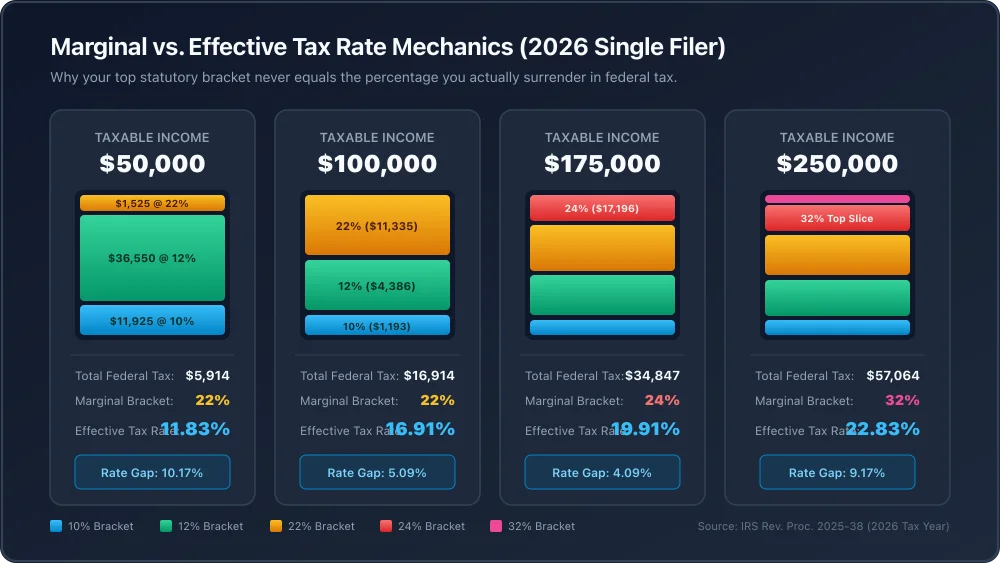
The United States federal income tax operates on a progressive bracket system administered under IRS Revenue Procedure 2025-38. Progressive taxation means that income is taxed in sequential slices or buckets. As your income rises, only the dollars that spill into higher brackets face higher statutory rates.
Think of your annual taxable income as water filling a row of buckets:
- Bucket 1 (10%): The first $11,925 of taxable income for a single filer is taxed at exactly 10%.
- Bucket 2 (12%): Dollars between $11,926 and $48,475 are taxed at 12%.
- Bucket 3 (22%): Dollars between $48,476 and $103,350 are taxed at 22%.
- Bucket 4 (24%): Dollars between $103,351 and $197,300 are taxed at 24%.
A promotion that pushes your earnings into Bucket 3 never changes the tax rate paid on the money resting in Bucket 1 or Bucket 2. Those dollars remain taxed at 10% and 12%, respectively. You never take home less total net pay by moving into a higher tax bracket.
2026 Federal Income Tax Brackets
The table below outlines the statutory federal income tax brackets for the 2026 tax year for Single and Married Filing Jointly (MFJ) filers.
| Tax Rate | Single Filers (Taxable Income) | Married Filing Jointly (Taxable Income) |
|---|---|---|
| 10% | $0 to $11,925 | $0 to $23,850 |
| 12% | $11,926 to $48,475 | $23,851 to $96,950 |
| 22% | $48,476 to $103,350 | $96,951 to $206,700 |
| 24% | $103,351 to $197,300 | $206,701 to $394,600 |
| 32% | $197,301 to $250,525 | $394,601 to $501,050 |
| 35% | $250,526 to $626,350 | $501,051 to $751,600 |
| 37% | Over $626,350 | Over $751,600 |
For 2026, the standard deduction is $16,100 for single filers, $32,200 for married couples filing jointly, and $24,150 for heads of household. Taxable income is calculated only after subtracting your standard deduction or allowable itemized deductions from your gross earnings.
What Is a Marginal Tax Rate?
Your marginal tax rate is the tax percentage applied to the very next dollar of taxable income you earn. It corresponds directly to the highest tax bracket your income reaches.
Financial planners use marginal rates to evaluate decision margins. When you negotiate an annual bonus, work overtime shifts, or liquidate short-term capital gains, your marginal tax rate determines the exact percentage the federal government retains.
Net Bonus Retention = Gross Bonus Amount × (1 - Marginal Tax Rate)
Determines your take-home pay on supplementary income after federal income tax withholding.
For example, consider a single worker earning $100,000 in taxable income. According to the 2026 statutory brackets, this individual sits in the 22% tax bracket. If that worker receives a $4,000 performance bonus, federal income tax claims 22% of that bonus ($880), leaving $3,120 in net income before state and payroll taxes.
What Is an Effective Tax Rate?
Your effective tax rate is the true blended percentage of your total income surrendered in federal taxes. It provides an honest picture of your overall annual tax burden because it accounts for lower bracket tiers, deductions, and non-taxable income allowances.
Effective Tax Rate (%) = (Total Federal Tax Liability ÷ Total Taxable Income) × 100
Computes your weighted average federal tax obligation across all progressive tax tiers.
Tax professionals also evaluate your effective tax rate against gross earnings:
Gross Effective Tax Rate (%) = (Total Federal Tax Liability ÷ Total Gross Income) × 100
Reflects your total tax liability relative to every gross dollar received prior to deductions.
Because progressive brackets start at 10% and standard deductions shield initial income entirely, your effective tax rate is always significantly lower than your top marginal bracket.
Calculate Your Exact Paycheck Withholding Model your net pay across federal brackets, state withholdings, and pre-tax deductions using our interactive Gross to Net Paycheck Calculator. If you need to reverse-engineer an agreed salary from a take-home target, run the figures through our Net to Gross Calculator.
Real-World Case Studies: Comparing Three Earners
To illustrate how progressive brackets decouple marginal rates from effective rates, let us examine three realistic taxpayer profiles for the 2026 tax year. All three individuals are single filers claiming the $16,100 standard deduction.
Case 1: Maria ($50,000 Taxable Income)
Maria works as a marketing coordinator with a gross salary of $66,100. Subtracting the $16,100 standard deduction leaves her with exactly $50,000 in taxable income.
Her tax liability fills three progressive brackets:
- 10% on the first $11,925: $1,192.50
- 12% on income from $11,926 to $48,475 ($36,550): $4,386.00
- 22% on income from $48,476 to $50,000 ($1,525): $335.50
- Total Federal Tax Liability: $1,192.50 + $4,386.00 + $335.50 = $5,914.00
Maria sits in the 22% marginal tax bracket. However, dividing her $5,914 tax liability by her $50,000 taxable income yields an effective tax rate of 11.83%. When evaluated against her gross salary of $66,100, her gross effective tax rate is just 8.95%.
Her marginal-to-effective rate gap is 10.17 percentage points (22.00% minus 11.83%). Only 3% of her total taxable earnings face the 22% rate.
Case 2: Alex ($100,000 Taxable Income)
Alex works as a software engineer earning $116,100 in gross wages. After the $16,100 standard deduction, his taxable income equals $100,000.
Alex also falls into the 22% marginal bracket, but his higher income fills more of that tier:
- 10% on the first $11,925: $1,192.50
- 12% on income from $11,926 to $48,475 ($36,550): $4,386.00
- 22% on income from $48,476 to $100,000 ($51,525): $11,335.50
- Total Federal Tax Liability: $1,192.50 + $4,386.00 + $11,335.50 = $16,914.00
Alex has a marginal tax rate of 22% and an effective tax rate of 16.91% ($16,914 / $100,000). On his gross earnings of $116,100, his gross effective rate is 14.57%.
Even though Maria and Alex share the same 22% marginal bracket, Alex pays an effective rate 5.08 percentage points higher than Maria because more of his income occupies the top tier.
Case 3: David ($175,000 Taxable Income)
David is a director of sales with a gross salary of $191,100. After the standard deduction, his taxable income is $175,000.
His income flows into the 24% tax tier:
- 10% on the first $11,925: $1,192.50
- 12% on income from $11,926 to $48,475 ($36,550): $4,386.00
- 22% on income from $48,476 to $103,350 ($54,875): $12,072.50
- 24% on income from $103,351 to $175,000 ($71,650): $17,196.00
- Total Federal Tax Liability: $1,192.50 + $4,386.00 + $12,072.50 + $17,196.00 = $34,847.00
David sits in the 24% marginal tax bracket. His effective tax rate is 19.91% ($34,847 / $175,000), and his gross effective rate is 18.23%.
Summary Comparison Table
The following comparison illustrates how marginal rates and effective rates diverge across income tiers:
| Metric | Maria | Alex | David |
|---|---|---|---|
| Gross Salary | $66,100 | $116,100 | $191,100 |
| Standard Deduction | $16,100 | $16,100 | $16,100 |
| Taxable Income | $50,000 | $100,000 | $175,000 |
| Top Marginal Bracket | 22.00% | 22.00% | 24.00% |
| Total Federal Tax | $5,914 | $16,914 | $34,847 |
| Effective Rate (Taxable) | 11.83% | 16.91% | 19.91% |
| Effective Rate (Gross) | 8.95% | 14.57% | 18.23% |
| Marginal vs. Effective Gap | 10.17% | 5.09% | 4.09% |
Notice that the gap between marginal and effective rates narrows as income expands. Higher earners push a greater proportion of their total income into upper tiers, causing their blended average rate to creep closer to their marginal cap.
Why This Distinction Matters for Tax Strategy
Understanding how both rates function allows you to execute precise tax planning rather than relying on guesswork.
1. Evaluating the Real Value of Tax Deductions
Tax deductions save money at your marginal tax rate, not your effective tax rate. Deductions remove taxable income from your highest bucket first.
Cash Tax Savings = Deductible Contribution Amount × Marginal Tax Rate
Calculates direct tax reduction achieved by pre-tax contributions or itemized write-offs.
If Alex contributes $10,000 to a traditional 401(k) or traditional IRA, that entire $10,000 is shaved off his 22% bracket. It reduces his federal tax bill by exactly $2,200 ($10,000 × 0.22), not by his 16.91% effective rate ($1,691). The tax deduction delivers an immediate 22% return on deferred capital.
2. The Traditional vs. Roth Retirement Arbitrage
The marginal-versus-effective tax distinction forms the foundation of the Roth versus Traditional retirement decision:
- Traditional Contributions: You save taxes today at your current marginal rate.
- Traditional Withdrawals in Retirement: You pay taxes tomorrow across progressive brackets, starting at 0% (standard deduction), 10%, and 12%, resulting in an effective rate on retirement distributions.
Consider David in the 24% marginal bracket. By placing $20,000 into a pre-tax traditional 401(k), he avoids paying 24% federal tax today, pocketing $4,800 in immediate tax relief.
When David retires, if he withdraws $70,000 per year from pre-tax accounts, that income will be taxed starting at the 0% standard deduction tier and moving up through the 10% and 12% tiers. His effective tax rate in retirement might be only 10% or 12%.
By contributing at a 24% marginal rate today and withdrawing at a 12% effective rate tomorrow, David captures a lucrative 12-percentage-point tax arbitrage.
3. Evaluating Overtime, Bonuses, and Side Hustles
Employees frequently worry about taking on overtime shifts or weekend freelance projects out of concern that extra earnings will push them into a higher bracket.
As established by progressive bracket mechanics, entering a higher bracket never reduces your baseline pay. If Alex earns an extra $5,000 of freelance net income that crosses from the 22% tier into the 24% tier:
- Dollars up to the $103,350 boundary are taxed at 22%.
- Only the specific dollars above $103,350 are taxed at 24%.
Alex retains at least 76 cents of every single federal dollar earned in the new tier. Knowing your marginal rate allows you to make clear-eyed decisions about whether supplementary work is worth your time after accounting for federal, state, and payroll levies.
If you generate self-employment or 1099 revenue on the side, monitor quarterly estimated payments with our Quarterly Estimated Tax Calculator to maintain safe-harbor compliance without overpaying the IRS.
Additional Taxes That Affect Your Total Effective Rate
Your federal income tax calculation is only one component of your overall tax footprint. To determine your comprehensive effective tax rate, you must incorporate state income taxes and statutory payroll contributions.
1. FICA Payroll Taxes (Social Security and Medicare)
Under the Federal Insurance Contributions Act (FICA), detailed by the Social Security Administration Contribution and Benefit Base, wage earners pay:
- Social Security Tax (OASDI): 6.2% on wages up to the 2026 statutory wage base limit of $184,500. Employers match this 6.2%.
- Medicare Tax: 1.45% on all covered wages with no upper cap. Employers match this 1.45%.
- Additional Medicare Tax: An extra 0.9% surtax assessed on wages exceeding $200,000 for single filers ($250,000 for married couples filing jointly).
Self-employed contractors and business owners pay both employee and employer portions, totaling 15.3% in self-employment taxes, though half of this amount is deductible against gross income. For an in-depth breakdown of paystub line items, explore our guide to understanding your paycheck stub. To reduce your net taxable baseline, review how to lower taxable income alongside our comprehensive catalog of common tax deductions.
2. State and Local Income Taxes (SALT)
State income tax structures vary significantly across the country:
- No Income Tax States: Alaska, Florida, Nevada, New Hampshire, South Dakota, Tennessee, Texas, Washington, and Wyoming impose no state levy on earned wages.
- Flat Tax States: States like Colorado (4.40%), Illinois (4.95%), and Pennsylvania (3.07%) tax all earned income at a single rate, aligning marginal and effective state rates.
- Progressive Tax States: States such as California (up to 13.3%), New York (up to 10.9%), and New Jersey (up to 10.75%) impose progressive bracket structures similar to the federal system.
When analyzing your comprehensive marginal rate on bonus income, add your federal marginal rate, state marginal rate, and Medicare tax (1.45% or 2.35%) to find your true retention figure.
Common Myths About Tax Rates Debunked
Misconceptions about tax brackets persist in workplace breakrooms and social media discussions. Review these three common fallacies to protect your financial decision-making.
Myth 1: Earning More Money Can Decrease Your Net Take-Home Pay
A reduction in net take-home pay caused solely by moving into a higher federal tax bracket is mathematically impossible within the progressive federal income tax structure. Because each tax rate applies solely to dollars within its specific boundary, your take-home pay strictly increases with every extra dollar earned.
The only exception occurs in rare edge cases involving means-tested public assistance benefits with abrupt income cutoffs (known as “benefits cliffs”). For standard wage earners subject to ordinary income tax brackets, higher gross pay always yields higher net pay.
Myth 2: Your Effective Rate Equals the Average of Your Brackets
A simple arithmetic average of bracket percentages (e.g., averaging 10%, 12%, and 22% to get 14.67%) does not determine your effective tax rate. Your effective rate is a weighted average based on the exact dollar quantity housed in each tier. If you have $40,000 in the 12% bucket and only $1,000 in the 22% bucket, your effective rate remains heavily weighted toward 12%.
Myth 3: Deductions Provide a Dollar-for-Dollar Tax Refund
A tax deduction is not a tax credit. A $1,000 tax credit reduces your tax liability dollar-for-dollar by $1,000. In contrast, a $1,000 tax deduction simply reduces your taxable income by $1,000. For an individual in the 22% marginal bracket, that $1,000 deduction cuts tax liability by $220.
Action Steps to Optimize Both Rates
- Calculate Your Current Marginal Bracket: Check your latest tax return or run your gross salary through our paycheck calculator to verify your top tax tier.
- Maximize Pre-Tax Vehicles at High Marginal Rates: If your marginal bracket is 24% or higher, prioritize traditional 401(k), traditional IRA, and Health Savings Account (HSA) contributions to lock in immediate deductions.
- Deploy Roth Strategies at Lower Marginal Rates: If you sit in the 10% or 12% marginal tier (or expect a career hiatus), consider funding Roth accounts or executing Roth conversions while bracket costs remain low.
- Itemize Strategically When Exceeding the Standard Deduction: If deductible expenses (mortgage interest, state taxes up to statutory caps, charitable contributions) surpass $16,100 (Single) or $32,200 (MFJ), itemize deductions on Schedule A to push taxable income into lower buckets.
This article is for educational purposes only and should not be considered personalized financial advice. Consider consulting with a financial advisor or tax professional for guidance specific to your situation.
Marginal vs. Effective Tax Rate FAQ
What is a marginal tax rate?
Your marginal tax rate is the tax percentage assessed on your next dollar of earned taxable income. In the progressive federal income tax system, it represents the highest tax bracket that your top tier of taxable income reaches.
What is an effective tax rate?
Your effective tax rate is the actual blended percentage of your total income paid in taxes. You calculate it by dividing your total annual tax liability by your total taxable income (or gross income) and multiplying by 100.
Which rate is higher, marginal or effective?
The marginal tax rate is higher than the effective tax rate for almost all taxpayers. Because the federal tax code applies graduated brackets, your income is taxed in layers at 10%, 12%, 22%, and above, keeping your blended average rate lower.
If I get a raise and enter a higher bracket, will my entire salary be taxed at that new rate?
No. Under the progressive US tax code, entering a higher tax bracket only taxes the specific dollars that exceed the bracket threshold at that higher percentage. Every dollar earned below that threshold remains taxed at the lower statutory rates.
Why is knowing both rates critical for retirement planning?
Your current marginal tax rate determines the immediate cash value of pre-tax deductions into a 401(k) or Traditional IRA. Conversely, your expected effective tax rate in retirement helps you evaluate whether a Roth conversion or Roth contribution delivers superior lifetime tax efficiency.

For educational purposes. Consider your own circumstances before making financial decisions. Read our editorial policy.
From reading to planning
Explore the numbers for yourself.
Use our free calculators to compare scenarios and understand your options.