Inherited IRA 10-Year Rule: Tax-Smoothing Strategies
Complete guide to the Inherited IRA 10-year rule under SECURE 2.0 and IRS Final Regulations. Discover tax-smoothing strategies to minimize RMD tax spikes.
For decades, non-spouse beneficiaries who inherited retirement accounts relied on a lucrative estate planning mechanism known as the “stretch IRA.” By distributing inherited balances incrementally over their own single life expectancies, beneficiaries allowed inherited pre-tax and Roth wealth to compound tax-sheltered across 30, 40, or even 50 years.
Congress permanently dismantled this strategy with the passage of the SECURE Act and SECURE 2.0. Today, most non-spouse heirs must fully drain inherited retirement accounts within a compressed 10-year window.
When paired with the Treasury Department’s final regulations requiring annual distributions for accounts inherited from older decedents, this 10-year mandate creates an aggressive tax trap. Mastering multi-year distribution timing is a critical component of advanced Roth conversion strategies designed to preserve family wealth against compounding income tax rates.
Key Takeaways
- The SECURE Act eliminated the lifetime stretch IRA for most non-spouse beneficiaries, replacing it with a strict 10-year complete liquidation mandate under IRC Section 401(a)(9)(H).
- Under the IRS final regulations, non-spouse beneficiaries must take annual single life expectancy RMDs in years 1 through 9 if the original owner died on or after their Required Beginning Date.
- Inherited Roth IRAs are exempt from annual RMDs in years 1 through 9, permitting 10 full years of unhindered, 100% tax-free compound growth.
- Deferring all withdrawals from an Inherited Traditional IRA until Year 10 creates a massive “tax bomb” that can push your income into the 37% federal tax bracket and trigger Medicare surcharges.
- Inherited IRAs are legally isolated from individual IRAs and do not trigger the Backdoor Roth pro-rata rule on IRS Form 8606.
The SECURE Act 10-Year Rule: How Beneficiary Rules Changed
The SECURE Act of 2019 and SECURE 2.0 Act fundamentally reorganized the beneficiary landscape into three distinct categories, eliminating long-term tax deferral for adult children and non-spouse relatives.
Historically, prior to the passage of the SECURE Act, anyone inheriting an IRA could stretch distributions over their remaining actuarial lifetime. A 30-year-old child inheriting a parent’s $500,000 IRA was required to withdraw only about 1.9% in the first year, leaving the vast majority of the balance to compound tax-deferred.
Under IRC Section 401(a)(9)(H), Congress replaced this lifetime stretch with the 10-year rule for all non-eligible designated beneficiaries.
| Beneficiary Category | Statutory Definition | Required Distribution Rules | Governing Timeline |
|---|---|---|---|
| Eligible Designated Beneficiary (EDB) | Surviving spouse, minor child of decedent (until 21), disabled, chronically ill, or individual not more than 10 years younger | Permitted to use lifetime stretch distributions based on single life expectancy | Lifetime stretch (or special spousal rollover) |
| Non-Eligible Designated Beneficiary | Adult children, grandchildren, siblings, and other individual non-spouse heirs | Subject to mandatory 10-year rule (with annual RMDs if decedent reached RBD) | 100% liquidated by Dec 31 of Year 10 |
| Non-Designated Beneficiary | Estates, non-qualifying trusts, charities | Subject to 5-year rule (if pre-RBD) or decedent’s remaining ghost life expectancy | 5-year rule or ghost single life expectancy |
For minor children of the deceased account owner, the lifetime stretch applies only until they reach the age of majority (defined federally as age 21). Once the child reaches age 21, the 10-year clock automatically triggers, requiring complete account depletion by December 31 of the year they turn age 31.
The IRS Final Regulations: When Annual RMDs Are Required (Years 1–9)
Following years of confusion and transitional penalty relief notices, the IRS established Treasury Decision 10001, finalizing the definitive distribution rules governing the 10-year window.
The central debate was whether beneficiaries who are subject to the 10-year rule could wait until Year 10 to take any distributions, or whether they had to take annual Required Minimum Distributions (RMDs) during years 1 through 9.
As published in government guidelines, the IRS Final Regulations established a critical distinction based on the decedent’s Required Beginning Date (RBD). Under current law, an individual’s RBD is April 1 of the calendar year following the year they reach age 73:
Rule 1: Decedent Died Before Reaching RBD (Under Age 73)
If the original account owner passed away before reaching their Required Beginning Date, the “at least as rapidly” rule under IRC Section 401(a)(9)(B)(i) does not apply.
- Beneficiaries have zero annual RMD requirements in years 1 through 9.
- You can withdraw money at any time, in any amount, or take zero distributions until Year 10.
- The entire account balance must be completely emptied by December 31 of the tenth calendar year following the owner’s death.
Rule 2: Decedent Died On or After Reaching RBD (Age 73+)
If the original account owner passed away on or after their Required Beginning Date, the beneficiary cannot pause distributions.
- Beneficiaries must take annual RMDs in years 1 through 9 based on their own single life expectancy.
- In addition to annual RMDs, the entire remaining balance must be completely emptied by December 31 of Year 10.
- Because the IRS waived missed RMD penalties for years between 2021 and 2024 under IRS Notice 2024-35, mandatory enforcement officially begins for the 2025 tax year.
Inherited Traditional vs. Inherited Roth IRAs: The 10-Year Strategic Contrast
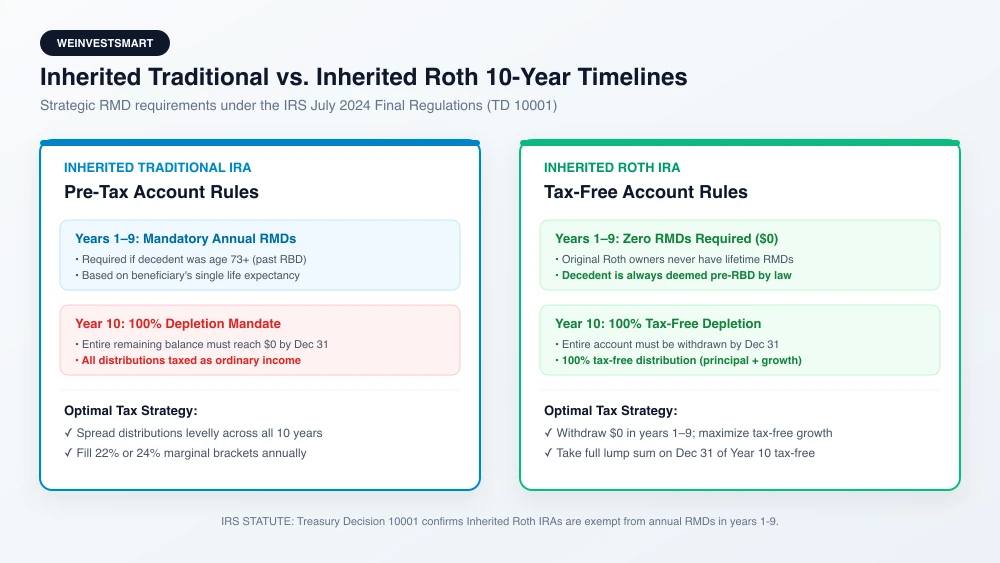
The 10-year rule applies to both Inherited Traditional IRAs and Inherited Roth IRAs, but their strategic management could not be more different.
Because pre-tax and Roth accounts operate under opposing tax frameworks, non-spouse beneficiaries must apply entirely different distribution timelines:
The Inherited Traditional IRA Challenge
Every dollar withdrawn from an Inherited Traditional IRA is taxed as ordinary income in the year distributed. If you leave the balance invested to compound for 10 years, the account grows larger, creating a massive taxable distribution that will be recognized in a single tax year.
The Inherited Roth IRA Superpower
Under federal tax law, original owners of Roth IRAs are never subject to lifetime RMDs. Consequently, every deceased Roth IRA owner is statutorily classified as having died before their Required Beginning Date, regardless of whether they passed away at age 65, 80, or 95.
Because the decedent died pre-RBD, the beneficiary of an Inherited Roth IRA has zero annual RMD requirements in years 1 through 9.
The optimal financial strategy for an Inherited Roth IRA is remarkably simple: withdraw exactly $0.00 during years 1 through 9. Allow the entire portfolio to compound 100% tax-free for all 10 years, and then execute a single complete tax-free withdrawal on December 31 of Year 10.
Tax-Smoothing Strategies: Defusing the Year 10 Tax Bomb
For beneficiaries of Inherited Traditional IRAs, the greatest financial danger is doing nothing and allowing the account to trigger the Year 10 tax bomb.
Most individuals inherit retirement assets during their peak career earnings years (typically ages 45 to 60). At this life stage, your household salary may already place you in the 24%, 32%, or 35% federal marginal tax bracket.
If you inherit a $400,000 Traditional IRA and defer all distributions until Year 10, compound growth at a 7% return will expand the balance to roughly $786,000. Forcing an extra $786,000 of ordinary income into a single tax return creates financial havoc:
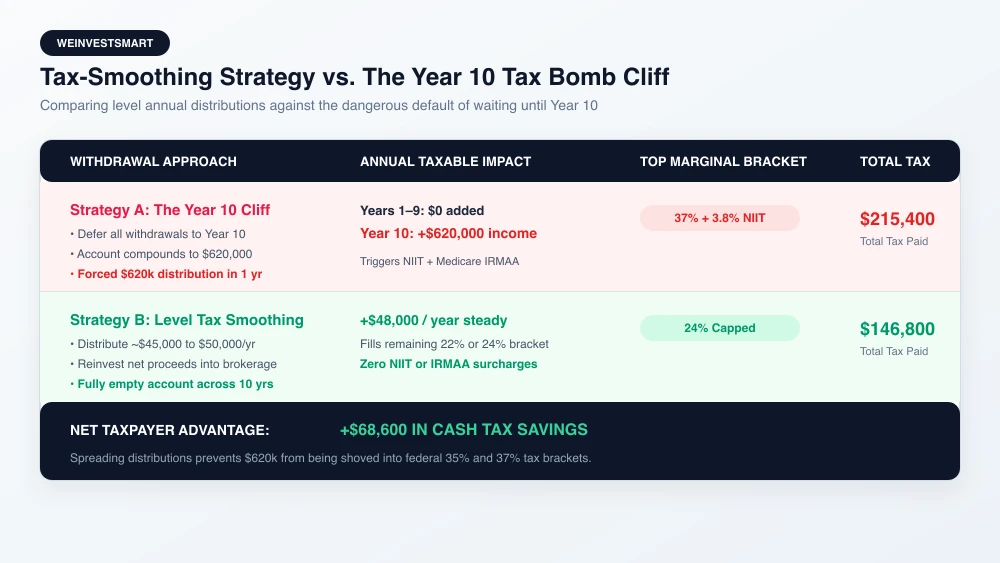
Collateral Damages of the Year 10 Cliff
- Top Marginal Bracket Spikes: The massive distribution pushes substantial portions of your income into the maximum 37% federal tax bracket.
- Net Investment Income Tax (NIIT): Surpassing modified adjusted gross income limits triggers the 3.8% NIIT surtax on all your taxable investment gains and dividends.
- Loss of Tax Credits and Exemptions: Higher adjusted gross income phases out child tax credits, student loan interest deductions, and itemized deduction thresholds.
- Medicare IRMAA Cliffs: For beneficiaries approaching age 63 or older, a one-year income spike triggers severe Income-Related Monthly Adjustment Amount (IRMAA) surcharges on Medicare Part B and Part D premiums two years later.
The Solution: Multi-Year Bracket Filling
Tax smoothing eliminates this cliff by intentionally taking distributions in years 1 through 10 to fill your current marginal tax bracket without crossing into higher brackets.
For example, if your baseline household income leaves $45,000 of space before entering the 32% bracket, you withdraw exactly $45,000 from the Inherited IRA each year. You pay 24% tax on each distribution and immediately reinvest the net after-tax proceeds into broad, low-cost index funds within a taxable brokerage account.
Concrete Case Study: Mark Inherits a $400,000 Traditional IRA
To see the exact dollar savings produced by multi-year tax smoothing, examine the situation of Mark, a 48-year-old engineering manager.
Mark earns a base salary of $145,000 annually. He files his taxes as single, placing his top taxable dollars in the 24% federal tax bracket (which in 2026 ends at $201,050 of taxable income).
Mark inherits a $400,000 Traditional IRA from his father, who passed away at age 75 (post-RBD). The account grows at an assumed 6.5% annualized return.
Approach 1: Taking Minimum RMDs and Withdrawing the Balance in Year 10
Under this approach, Mark takes only the mandatory single life expectancy RMD in years 1 through 9 (averaging roughly $15,000 to $20,000 per year) and drains the entire remaining balance of approximately $540,000 in Year 10:
- Years 1–9 Total Distributions: ~$158,000 (taxed at 24% and 32% brackets) = $42,660 tax.
- Year 10 Forced Distribution: $540,000. Added to his $145,000 salary, his Year 10 taxable income reaches $685,000.
- Year 10 Tax on IRA: $192,400 (substantial portions taxed at 35% and 37% brackets plus NIIT).
- Total Combined 10-Year Tax Paid: $235,060
Approach 2: Strategic Level Tax Smoothing Across 10 Years
Instead of waiting, Mark calculates an optimized level withdrawal of $55,000 each year across all 10 years:
- In each of the 10 years, Mark withdraws $55,000 from the Inherited IRA.
- Added to his $145,000 salary, his taxable income reaches $200,000, staying right under the 32% bracket boundary.
- Every single dollar of the inherited IRA is taxed at his current 24% rate.
- Mark takes the after-tax proceeds ($41,800 annually) and deposits them into a taxable brokerage account invested in index funds.
- Total Combined 10-Year Tax Paid: $132,000
| Performance Metric | Approach 1: Year 10 Cliff | Approach 2: Level Tax Smoothing | Net Taxpayer Advantage |
|---|---|---|---|
| Average Tax Rate on Distributions | 33.7% | 24.0% | -9.7% Lower Effective Rate |
| Top Marginal Bracket Reached | 37.0% (Max Federal) | 24.0% (Capped) | Zero High-Bracket Exposure |
| Exposure to 3.8% NIIT Surtax | High ($540k spike) | $0.00 | Avoided completely |
| Total 10-Year Income Tax Paid | $235,060 | $132,000 | +$103,060 Cash Tax Savings |
| Net Wealth Retained by Mark | $462,940 | $566,000 | +$103,060 Greater Wealth |
By spreading distributions smoothly across the entire 10-year window, Mark saves over $100,000 in unnecessary taxes on the exact same underlying inheritance.
To model how retirement account distributions interact with compounding growth and income tax projections, evaluate your baseline savings trajectory with our Traditional and Roth IRA Calculator.
Segregation Rules: Why Inherited IRAs Never Trigger the Pro-Rata Rule
A frequent concern among high-earning investors is whether holding an Inherited Traditional IRA will interfere with their ability to execute annual Backdoor Roth IRA conversions.
If you have studied the mechanics of the Backdoor Roth pro-rata rule, you know that holding pre-tax assets in a Traditional or Rollover IRA triggers proportional taxation on nondeductible conversions.
Fortunately, statutory tax law provides a total safe harbor for inherited accounts.
Statutory Account Segregation Under IRC §408
Under federal tax law, an Inherited IRA cannot be commingled with an individual’s personal retirement assets. The account remains tied to the deceased owner’s tax identification number and must be titled specifically to reflect its beneficiary status.
Because of this statutory barrier:
- You can never execute a reverse rollover from an Inherited IRA into your workplace 401(k) plan.
- You can never roll an Inherited IRA into your personal Traditional IRA or Roth IRA.
- Form 8606 Line 6 Exemption: When calculating your aggregate non-Roth IRA balance on Form 8606 Line 6, the IRS explicitly excludes Inherited IRAs.
Your Inherited Traditional IRA balance has zero impact on your personal Backdoor Roth conversions. You can hold a $500,000 Inherited IRA while executing 100% tax-free backdoor conversions annually, provided your personal non-inherited IRAs remain at zero.
The 5-Step Implementation Protocol: Managing an Inherited IRA
Managing an inherited retirement account requires precise administrative handling from day one to avoid triggering accidental taxable distributions or missing statutory deadlines.
Follow this five-step operational roadmap to establish and maintain an Inherited IRA:
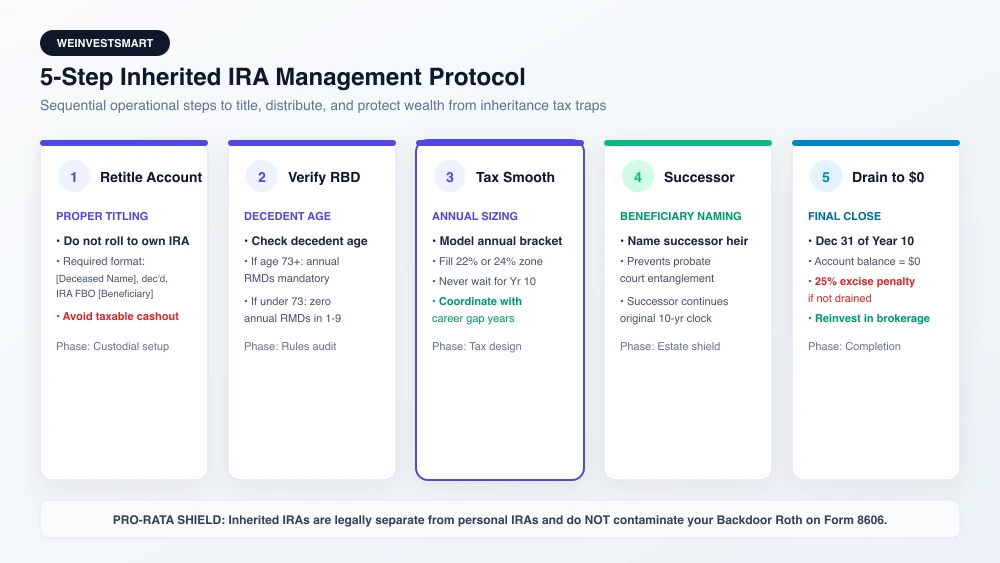
Step 1: Retitle the Account Properly
Never instruct the custodian to deposit the funds into your personal IRA or cash out the balance to a bank account. You must establish a new “Inherited IRA” (also known as a Beneficiary IRA) at the custodian of your choice.
The account title must strictly follow IRS format: [Deceased Owner’s Name], deceased [Date of Death], IRA FBO [Your Name], Beneficiary.
Step 2: Determine Decedent’s Age and Year-of-Death RMD
Check the decedent’s date of birth to confirm whether they had reached age 73 (their Required Beginning Date). If the decedent passed away after reaching age 73 and had not yet taken their full RMD for the calendar year of death, you as the beneficiary must take that year-of-death RMD before December 31 of the death year.
Step 3: Establish Your 10-Year Calendar
The 10-year clock begins on January 1 of the calendar year following the year of death. For example, if the account owner passed away in March 2025, Year 1 begins on January 1, 2026. The entire account balance must be fully distributed by December 31, 2035.
Step 4: Model and Schedule Multi-Year Distributions
Do not default to taking only the minimum single life expectancy RMD. Review your household tax bracket and project future career changes, such as upcoming sabbaticals, early retirement, or business startup years. Schedule annual distributions to systematically fill lower tax brackets while steering clear of US stealth marginal tax traps like Medicare IRMAA cliffs and net investment surtaxes.
Step 5: Designate Successor Beneficiaries
Immediately upon opening the Inherited IRA, complete a primary and contingent beneficiary designation form.
If you pass away before the 10-year window expires, your designated successor beneficiary inherits the remaining assets without passing through probate court. Under the SECURE Act, the successor beneficiary does not receive a new 10-year clock; they simply step into your shoes and must finish liquidating the remaining balance by the original December 31 deadline.
Frequently Asked Questions
What is the Inherited IRA 10-year rule?
The 10-year rule is a statutory provision under IRC Section 401(a)(9)(H) requiring non-eligible designated beneficiaries who inherit a retirement account after 2019 to fully liquidate the entire account balance by December 31 of the tenth year following the original owner’s death.
Are annual RMDs required during years 1 through 9 under the 10-year rule?
Under the IRS final regulations, annual RMDs are mandatory in years 1 through 9 if the original account owner died on or after their Required Beginning Date (age 73). If the owner died before their Required Beginning Date, annual RMDs are not required in years 1 through 9.
Do Inherited Roth IRAs require annual RMDs under the 10-year rule?
No. Because Roth IRA owners are never subject to lifetime RMDs, the decedent is always deemed to have died before their Required Beginning Date. Beneficiaries of an Inherited Roth IRA have zero required distributions in years 1 through 9 and must only empty the account by the end of year 10.
Does an Inherited IRA trigger the Backdoor Roth pro-rata rule?
No. Inherited IRAs are held under the deceased owner’s tax identity and are legally excluded from the beneficiary’s personal IRA aggregation calculation on Form 8606 Line 6.
What is the penalty for failing to take an Inherited IRA RMD?
Under the SECURE 2.0 Act, the excise tax penalty for failing to take a required minimum distribution was reduced from 50% to 25%, with a further reduction to 10% if the missed distribution is corrected in a timely manner.
This article is for educational purposes only and should not be considered personalized financial advice. Consider consulting with a financial advisor for guidance specific to your situation.
For educational purposes. Consider your own circumstances before making financial decisions. Read our editorial policy.
From reading to planning
Explore the numbers for yourself.
Use our free calculators to compare scenarios and understand your options.