Net Unrealized Appreciation: When to Keep Stock Out of an IRA
Net Unrealized Appreciation (NUA): learn when moving 401(k) company stock to a taxable account lets you pay capital gains rates instead of income tax.

When leaving a company or transitioning into retirement, the standard financial advice given to departing employees is nearly automatic: roll your entire 401(k) balance directly into a Traditional IRA. For diversified index funds, bond portfolios, and target-date retirement funds, this standard advice preserves tax deferral and avoids immediate tax liabilities.
However, if your retirement plan contains highly appreciated employer company stock, blindly following standard rollover advice can result in a devastating financial mistake. Rolling company stock into an Individual Retirement Account permanently converts low-tax capital gains into high-bracket ordinary income.
Under federal tax law, an alternative mechanism known as Net Unrealized Appreciation (NUA) provides a powerful escape hatch. As a cornerstone of advanced Roth conversion strategies and retirement distribution planning, the NUA rule allows investors to bypass ordinary income tax rates on the vast majority of their employer stock growth.
Key Takeaways
- Net Unrealized Appreciation under IRC Section 402(e)(4) allows employees to transfer company stock from a 401(k) to a taxable account, paying ordinary income tax only on the original cost basis.
- The unrealized growth (NUA) is completely exempt from tax at distribution and receives automatic long-term capital gains tax rates when sold, regardless of the holding duration outside the plan.
- To qualify for NUA, you must experience a statutory trigger event (separation from service, age 59½, disability, or death) and execute a total lump-sum distribution of the plan within a single tax year.
- Rolling company stock into a Traditional IRA permanently destroys NUA eligibility; once inside an IRA, all future distributions are taxed as ordinary income up to 37%.
- The NUA portion does not receive a step-up in basis at death under Revenue Ruling 75-125, making charitable gifting or strategic lifetime liquidation essential.
What Is Net Unrealized Appreciation (NUA) and How Does It Work?
Net Unrealized Appreciation is the increase in the value of employer securities while held inside a qualified retirement plan, defined as the current fair market value minus the plan’s original acquisition cost basis.
Under standard retirement plan distributions, every dollar withdrawn from a Traditional 401(k) or Traditional IRA is taxed at federal ordinary income rates, which reach as high as 37%. You receive zero credit for the fact that the underlying asset grew as an equity investment over decades of employment.
The NUA tax rule breaks this uniformity by dividing your employer stock into two distinct components: the original cost basis and the net unrealized appreciation.
| Plan Evaluation Metric | Standard Traditional IRA Rollover | Net Unrealized Appreciation (NUA) |
|---|---|---|
| Account Destination | Rollover IRA | Taxable Brokerage Account |
| Tax Due in Distribution Year | $0 (Direct rollover) | Ordinary income tax on Cost Basis only |
| Tax Rate on Stock Growth | Ordinary income tax (10% to 37%) | Long-term capital gains tax (0%, 15%, or 20%) |
| Holding Period Requirement | N/A (Always ordinary income) | Immediate LTCG status on NUA portion |
| Required Minimum Distributions | Full account subject to RMDs at age 73/75 | Zero RMDs (Held in taxable brokerage) |
| Early Withdrawal Penalties | 10% penalty if withdrawn before 59½ | 10% penalty applies only to basis if under 55 |
Under IRC Section 402(e)(4), Congress established that when employer securities are distributed as part of a lump-sum distribution, the net unrealized appreciation is excluded from gross income in the year of distribution.
Instead of paying ordinary income tax on the entire market value, you pay ordinary income tax only on the original price your plan paid to acquire the shares. The remaining gain is deferred until you actually sell the shares in your taxable brokerage account.
The Four Mandatory Trigger Events and Lump-Sum Distribution Rules
The NUA strategy is governed by strict statutory requirements. If you fail to meet even one statutory condition, the IRS will disqualify the distribution and treat the entire fair market value as immediate ordinary income.
To execute NUA, your distribution must satisfy two primary legal tests: a qualifying trigger event and a complete lump-sum distribution within a single calendar tax year.
The Four Statutory Trigger Events
Under IRC Section 402(e)(4)(D), you can execute an NUA distribution only after experiencing at least one of four qualifying life events:
- Separation from Service: Leaving your employer through voluntary resignation, retirement, layoff, or termination (available only to common-law employees).
- Attainment of Age 59½: Reaching age 59½ while still actively employed, provided your employer’s plan allows in-service distributions.
- Total and Permanent Disability: Becoming permanently disabled (under statutory definitions applicable to self-employed individuals).
- Death: The death of the plan participant, allowing designated beneficiaries to execute NUA on inherited plan assets.
Crucially, an employee cannot use reaching age 55 or early retirement buyouts as an independent trigger event. Separation from service serves as the trigger event, but once you separate, you must not take piecemeal partial distributions that taint future lump-sum eligibility.
The Single Calendar Year Lump-Sum Rule
The tax code strictly dictates that the participant’s entire account balance across all qualified plans of the same type maintained by that employer must be distributed within a single calendar tax year.
If you distribute stock to a brokerage account in October, you must also roll over or distribute all remaining diversified assets (such as mutual funds, cash, and bonds) before midnight on December 31 of that same year. Leaving even one dollar inside the employer 401(k) past December 31 invalidates the lump-sum distribution and destroys NUA tax treatment for that trigger event.
Be mindful of the common trap of taking a partial distribution in year one and attempting NUA in year two. That first distribution closes the window for that specific trigger event unless you reach a subsequent trigger event, such as reaching age 59½.
The Tax Math: Cost Basis vs. NUA vs. Post-Distribution Growth
To evaluate whether NUA is financially advantageous, you must understand how the IRS taxes the three distinct economic layers of your stock position.
The total fair market value of employer securities distributed under NUA is broken into three chronological segments:
- Layer 1: The Cost Basis. This represents the dollar amount paid by the retirement plan trust when purchasing the shares for your account. You owe ordinary income tax on this amount in the calendar year of distribution.
- Layer 2: The Net Unrealized Appreciation (NUA). This represents the appreciation that accrued from the date the shares were acquired until the date they were distributed to your taxable brokerage account. This gain is taxed as long-term capital gains only when the shares are sold.
- Layer 3: Post-Distribution Appreciation. This represents any additional market growth that occurs after the distribution date while the stock sits in your brokerage account. This gain is subject to standard holding period rules.
The mathematical formula governing the NUA tax separation is:
Net Unrealized Appreciation = Fair Market Value at Distribution - Plan Cost Basis
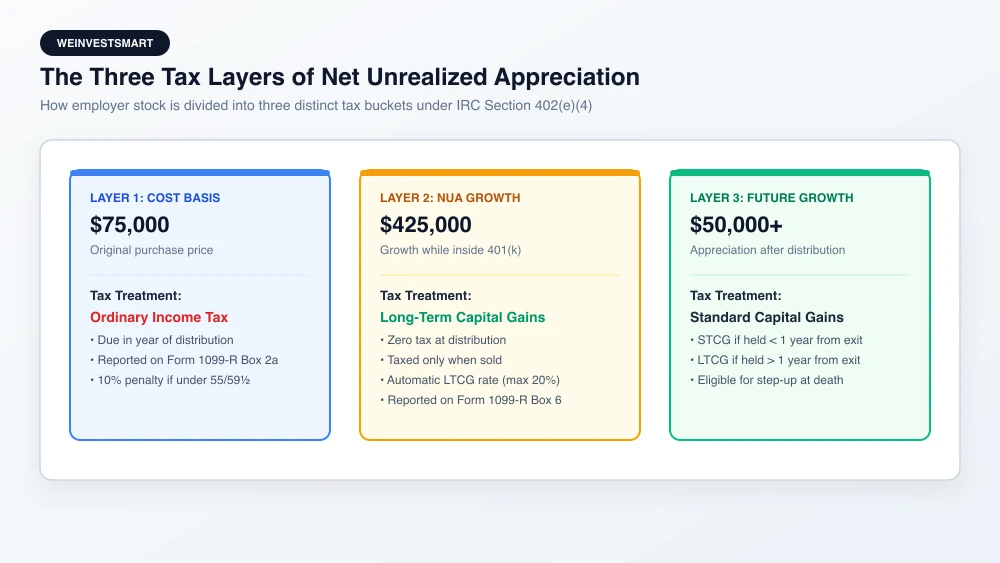
A major advantage of Layer 2 is that the IRS automatically grants long-term capital gains status to the NUA portion, even if you sell the stock the very next morning after distribution.
However, Layer 3 (any additional growth occurring after the distribution date) requires you to hold the stock for more than one year from the distribution date to qualify as a long-term capital gain, as detailed in our analysis of long-term vs short-term capital gains. If sold within 12 months, Layer 3 growth is taxed as short-term ordinary income.
NUA vs. Traditional IRA Rollover vs. Roth Conversion
Choosing between NUA and an IRA rollover requires weighing immediate tax costs against future capital gains tax savings and portfolio concentration risks.
The NUA strategy is not an automatic victory for every investor with company stock. In certain scenarios, rolling the shares into a Traditional IRA or executing a Roth conversion produces a superior long-term net return.
| Evaluation Factor | NUA Strategy Favored | Traditional IRA Rollover Favored | Roth Conversion Favored |
|---|---|---|---|
| Cost Basis Ratio | Low cost basis (< 20% to 25% of value) | High cost basis (> 50% to 60% of value) | Moderate basis with low current income |
| Tax Bracket Today | Low to moderate ordinary income bracket | High current tax bracket; cannot absorb basis tax | Low income transition year (sabbatical/early retirement) |
| Tax Bracket in Retirement | High expected retirement bracket (32% to 37%) | Expected low retirement bracket (10% to 12%) | Anticipate higher tax rates in the future |
| Investment Horizon | Short to medium horizon; desire to diversify | Long horizon (25+ years); tax deferral dominates | Extremely long horizon (tax-free compounding wins) |
| Portfolio Concentration | High desire to sell stock immediately at 15% rate | Comfortable holding diversified assets | Willing to pay tax upfront for total tax freedom |
Use this diagnostic decision framework to determine the optimal pathway for your specific stock holdings:
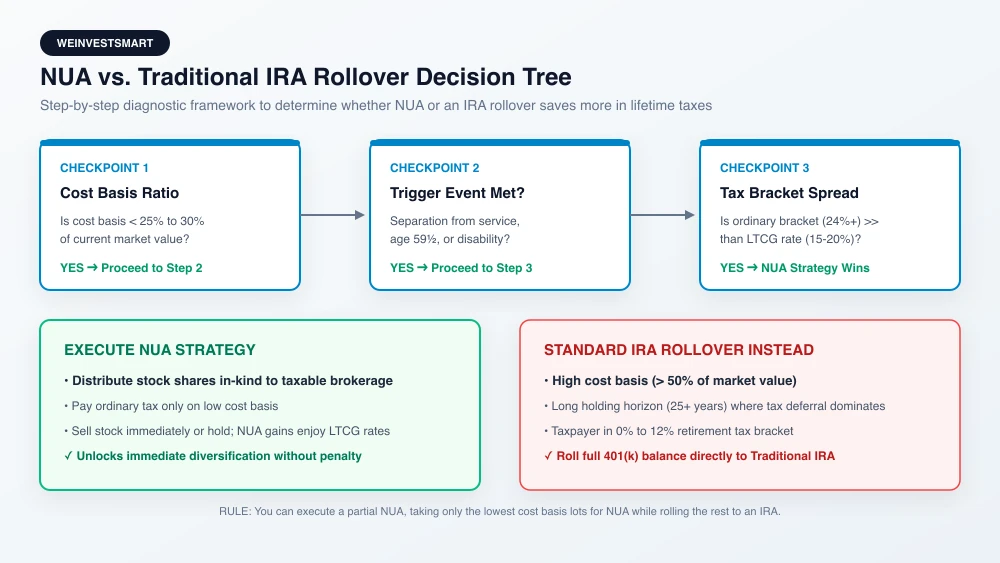
If you have multiple lots of company stock purchased at varying share prices over your career, you are not forced into an all-or-nothing choice. You can execute a partial NUA.
Under IRS rules, you can instruct your plan recordkeeper to distribute only your lowest cost basis share lots to your taxable brokerage account for NUA treatment. You can simultaneously direct the highest cost basis lots (where appreciation is minimal) into a Traditional IRA alongside your other mutual funds.
This split execution shields you from unnecessary upfront ordinary income taxes. Managing this distribution carefully prevents ordinary basis income from pushing your tax return into US stealth marginal tax traps, such as the 3.8% Net Investment Income Tax or Medicare IRMAA cliffs.
Concrete Case Study: Sarah Liquidates $500,000 of Company Stock
To examine the concrete dollar savings generated by NUA tax arbitrage, examine the situation of Sarah, a 60-year-old corporate director retiring after 25 years of service.
Sarah holds $500,000 worth of employer stock inside her 401(k) plan. Over her tenure, her company purchased these shares through profit-sharing contributions at an aggregate cost basis of $75,000. Sarah also holds $600,000 in diversified index funds in the same plan.
Her federal marginal income tax bracket is 35%, and her long-term capital gains tax rate is 15% (plus the 3.8% Net Investment Income Tax, totaling 18.8%).
Option A: Standard Rollover to Traditional IRA
If Sarah rolls her entire $1.1 million 401(k) into a Rollover IRA, she owes zero taxes today. However, to eliminate concentration risk, she decides to sell the $500,000 stock position inside the IRA and purchase diversified index funds.
When Sarah later withdraws that $500,000 over her retirement years, every dollar is taxed as ordinary income at her 35% rate:
- Total Taxable Amount: $500,000
- Applicable Tax Rate: 35% ordinary income
- Total Lifetime Tax Paid: $175,000
- Net After-Tax Proceeds: $325,000
Option B: The NUA Distribution Strategy
Sarah executes an NUA distribution in November following her retirement:
- She rolls her $600,000 in diversified index funds directly into a Traditional IRA tax-free.
- She transfers the $500,000 in company stock in-kind to her taxable brokerage account.
- In the tax year of distribution, she reports her $75,000 cost basis as ordinary income, paying 35% tax on the basis ($26,250).
- She immediately sells the stock in her brokerage account to eliminate concentration risk, realizing $425,000 of NUA taxed at the 18.8% capital gains rate ($79,900).
| Tax Component | Option A: Full IRA Rollover | Option B: NUA Strategy | Net Difference (NUA Advantage) |
|---|---|---|---|
| Ordinary Income Tax on Basis | $0 today ($26,250 on basis later) | $26,250 (35% on $75k) | Paid upfront |
| Tax on Stock Appreciation ($425k) | $148,750 (35% ordinary rate) | $79,900 (18.8% LTCG + NIIT) | $68,850 Tax Savings |
| Total Federal Tax Paid | $175,000 | $106,150 | +$68,850 Cash Savings |
| Net Cash in Sarah’s Pocket | $325,000 | $393,850 | +21.2% Greater Net Wealth |
By using the NUA strategy, Sarah pockets an extra $68,850 in net wealth on the exact same asset simply by altering its tax character from ordinary income to long-term capital gains.
To model how different withdrawal strategies and retirement balances interact over multi-decade retirements, analyze your plan balances using our 401(k) Retirement Calculator.
The Estate Planning Trap: No Step-Up in Basis for NUA at Death
While NUA provides extraordinary lifetime income tax arbitrage, it presents a major estate planning trap that catches many retirees unprepared.
Under standard estate tax rules governing taxable brokerage accounts, assets held at death receive a step-up in basis to fair market value under IRC Section 1014. If you purchase stock outside a retirement plan and hold it until death, your heirs inherit the shares with all built-in capital gains completely forgiven.
NUA and Income in Respect of a Decedent (IRD)
Unfortunately, the NUA portion of employer stock does not qualify for a stepped-up basis at death.
Under IRS Revenue Ruling 75-125, the IRS determined that the net unrealized appreciation element constitutes Income in Respect of a Decedent (IRD) under IRC Section 691.
When your beneficiaries inherit NUA stock:
- The built-in NUA gain carries over to the heirs with zero step-up in basis.
- When the heirs eventually sell the stock, they must pay long-term capital gains tax on the original NUA amount.
- Only the growth that occurred after the stock was distributed from the 401(k) to the taxable brokerage account receives a stepped-up basis under Section 1014.
Strategic Solutions for NUA Estate Planning
Because NUA gains do not receive a step-up in basis at death, leaving NUA shares in your portfolio until you pass away is often suboptimal. Wealth advisors use three specific estate planning techniques to neutralize this issue:
- Strategic Lifetime Liquidation: Sell the NUA stock during retirement years when your capital gains rate is 15% or 0%, reinvesting the proceeds into diversified assets that will receive a full step-up in basis upon death.
- Charitable Donation: Donate NUA shares directly to a public charity or a Donor-Advised Fund (DAF). You claim a charitable deduction equal to the full fair market value while permanently eliminating all capital gains taxes on both the basis and the NUA.
- Gift to Lower-Bracket Family Members: Gift shares during your lifetime to children or grandchildren who fall into the 0% long-term capital gains bracket (taxable income under $96,700 for married couples filing jointly in 2026).
The 5-Step Implementation Protocol: Executing a Flawless NUA
Executing an NUA transfer requires strict coordination between your employer benefits department, the 401(k) recordkeeper, and your brokerage custodian.
Follow this five-step operational roadmap to execute the transfer cleanly and ensure accurate tax reporting:
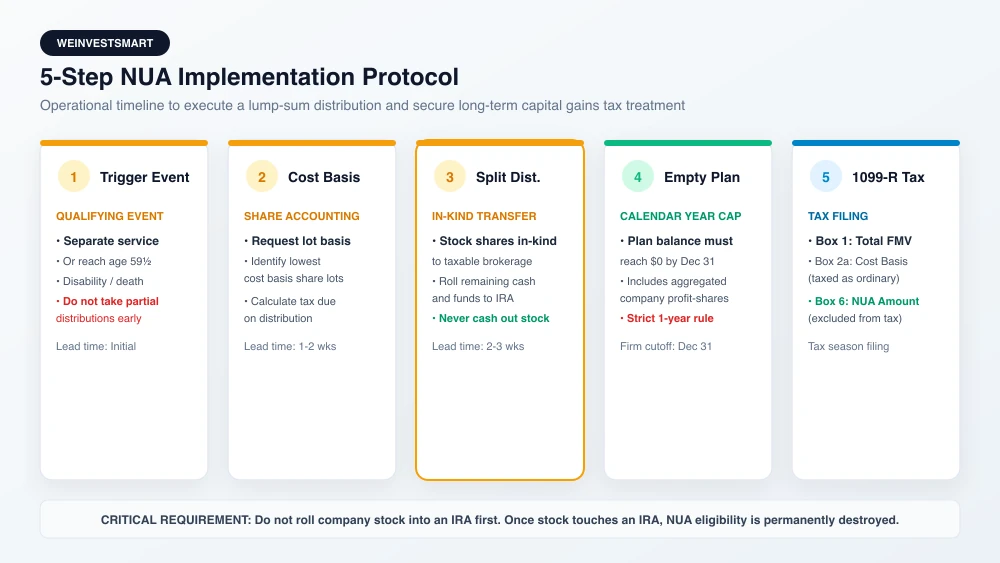
Step 1: Verify Trigger Event and Plan Rules
Confirm that you have experienced a bona fide trigger event (such as separation from service). Review your Summary Plan Description (SPD) to confirm that your 401(k) allows in-kind share distributions of employer securities.
Step 2: Request Share Lot Accounting
Contact the 401(k) recordkeeper and request a detailed breakdown of your employer stock holdings by share purchase lot. Identify the cost basis of each lot so you can isolate the lowest-basis shares for NUA and designate high-basis shares for an IRA rollover.
Step 3: Initiate the Split Distribution
Open two accounts at your destination brokerage firm: a Rollover Traditional IRA and a standard individual taxable brokerage account. Submit distribution paperwork directing the custodian to:
- Transfer the selected company stock shares in-kind directly into your taxable brokerage account.
- Transfer all remaining plan assets (cash, mutual funds, non-company stock) via direct institutional rollover into your Rollover IRA.
Never liquidate the company stock to cash inside the 401(k). The shares must be transferred in-kind as actual stock certificates or electronic book-entry shares to preserve NUA eligibility.
Step 4: Empty the Plan by December 31
Ensure that all distributions and rollovers settle within the same calendar year. Log into your employer benefits portal before year-end to verify that the remaining balance across all employer retirement plans displays as zero.
Step 5: Tax Reporting Reconciliation on Form 1099-R
In January following the distribution year, your plan recordkeeper will issue IRS Form 1099-R documenting the transaction:
- Box 1 (Gross Distribution): Reflects the total fair market value of all distributed assets.
- Box 2a (Taxable Amount): Reflects only the cost basis of the company stock distributed to the taxable account.
- Box 6 (Net Unrealized Appreciation): Displays the exact dollar amount of NUA, confirming that this growth is excluded from current-year taxable income.
- Box 7 (Distribution Code): Displays Code 1 (early distribution without exception) or Code 7 (normal distribution depending on age).
When you eventually sell the stock in your taxable account, the brokerage will issue Form 1099-B, reporting the sale with the original cost basis from your 1099-R Box 2a, allowing you to pay long-term capital gains tax on the NUA gain.
Frequently Asked Questions
What is Net Unrealized Appreciation (NUA)?
Net Unrealized Appreciation (NUA) is a tax provision under IRC Section 402(e)(4) allowing employees holding employer stock in a qualified plan to distribute the shares to a taxable brokerage account, paying ordinary income tax only on the original cost basis while taxing the remaining growth at long-term capital gains rates upon sale.
What are the qualifying trigger events for an NUA distribution?
Under IRC Section 402(e)(4)(D), the four qualifying trigger events are separation from service (retirement, resignation, layoff), reaching age 59½, total and permanent disability, or death.
Does NUA stock receive a step-up in basis at death?
No. Under IRS Revenue Ruling 75-125, the NUA portion is classified as Income in Respect of a Decedent (IRD) and does not receive a step-up in basis. However, any post-distribution growth above the NUA value does qualify for a stepped-up basis under IRC Section 1014.
Can you do NUA on part of your company stock and roll the rest to an IRA?
Yes. You can cherry-pick specific share lots with the lowest cost basis for NUA treatment while rolling higher basis lots and diversified mutual funds into a Traditional IRA.
What happens if you accidentally roll company stock into an IRA first?
Rolling employer stock into an IRA irrevocably destroys NUA eligibility. Once the shares land in an IRA, all future distributions are permanently taxed as ordinary income, forfeiting capital gains tax rates.
This article is for educational purposes only and should not be considered personalized financial advice. Consider consulting with a financial advisor for guidance specific to your situation.
For educational purposes. Consider your own circumstances before making financial decisions. Read our editorial policy.
From reading to planning
Explore the numbers for yourself.
Use our free calculators to compare scenarios and understand your options.