Mega Backdoor Roth Step-by-Step: After-Tax 401(k) In-Plan Conversions
Mega Backdoor Roth guide: use after-tax 401(k) contributions and in-plan Roth conversions to save up to $72,000 a year in 2026. Check if your plan allows it.
High-income professionals who have already maximized their standard $24,500 salary deferral frequently hit an artificial ceiling in their retirement planning. Standard Roth IRA contributions are phased out once modified adjusted gross income exceeds statutory thresholds, leaving high earners with limited avenues for tax-exempt compounding.
Fortunately, workplace retirement plans governed by the Internal Revenue Code offer an extraordinary solution known as the Mega Backdoor Roth. By utilizing voluntary after-tax 401(k) contributions paired with automated in-plan conversions, investors can funnel up to an additional $47,500 per year into permanent tax-free accounts.
This strategy forms a vital pillar of advanced Roth conversion strategies by bypassing standard IRA contribution caps entirely. When implemented correctly, it enables households to accumulate millions of dollars in tax-free assets throughout their peak earning years.
Key Takeaways
- The Mega Backdoor Roth allows employees to contribute voluntary after-tax dollars to a 401(k) beyond the standard $24,500 elective deferral limit.
- Under Internal Revenue Code Section 415(c)(1)(A), total combined plan contributions from employee deferrals, employer contributions, and after-tax dollars are capped at $72,000 for 2026.
- To execute the strategy, your workplace plan document must permit voluntary after-tax non-Roth contributions and either automated in-plan Roth conversions or in-service non-hardship distributions.
- Under IRS Notice 2014-54, after-tax contributions can be split during an in-service rollover, routing after-tax principal to a Roth IRA and untaxed earnings to a Traditional IRA.
- The Mega Backdoor Roth is completely immune to the individual IRA pro-rata aggregation rule that restricts standard Backdoor Roth IRA conversions.
What Is the Mega Backdoor Roth and How Does It Work?
The Mega Backdoor Roth is an advanced retirement savings strategy where an employee makes voluntary after-tax contributions to an employer-sponsored 401(k) plan up to the statutory Section 415(c) limit, followed by an immediate conversion into a Roth 401(k) or Roth IRA.
Many investors confuse a standard Roth 401(k) with voluntary after-tax 401(k) contributions. A standard Roth 401(k) contribution is an elective salary deferral governed by IRC Section 402(g). It shares the standard $24,500 annual limit with pre-tax contributions.
In contrast, voluntary after-tax contributions sit in an entirely separate bucket within your plan. They do not count toward your personal $24,500 elective deferral limit. Instead, they are bounded only by the total defined contribution plan additions ceiling.
| Comparison Feature | Standard Roth 401(k) Deferral | Traditional Backdoor Roth IRA | Mega Backdoor Roth 401(k) |
|---|---|---|---|
| Annual Contribution Limit | $24,500 (combined with pre-tax) | $7,000 ($8,000 if age 50+) | Up to $47,500+ after-tax headroom |
| Overall Plan Ceiling (2026) | $24,500 elective cap | N/A (Individual account) | $72,000 total plan additions limit |
| Statutory Authority | IRC §402(g) | IRC §408A | IRC §415(c)(1)(A) & Notice 2014-54 |
| Income Phaseout Limits | None | Indirectly bypassed via non-deductible IRA | None (Available to any income level) |
| Pro-Rata Rule Exposure | None | High (Aggregates all traditional IRAs) | Zero (Employer plans are exempt) |
| Account Destination | Designated Roth 401(k) | Roth IRA | Roth 401(k) or Roth IRA |
Because contributions to this secondary bucket consist of after-tax capital, you receive no upfront tax deduction. However, once those dollars are converted into Roth status, all future compound growth and subsequent qualified distributions become 100% tax-free forever.
The Three Mandatory 401(k) Plan Prerequisites
The Mega Backdoor Roth is not a universal statutory right available in every retirement plan. It requires explicit administrative provisions within your employer’s Summary Plan Description (SPD).
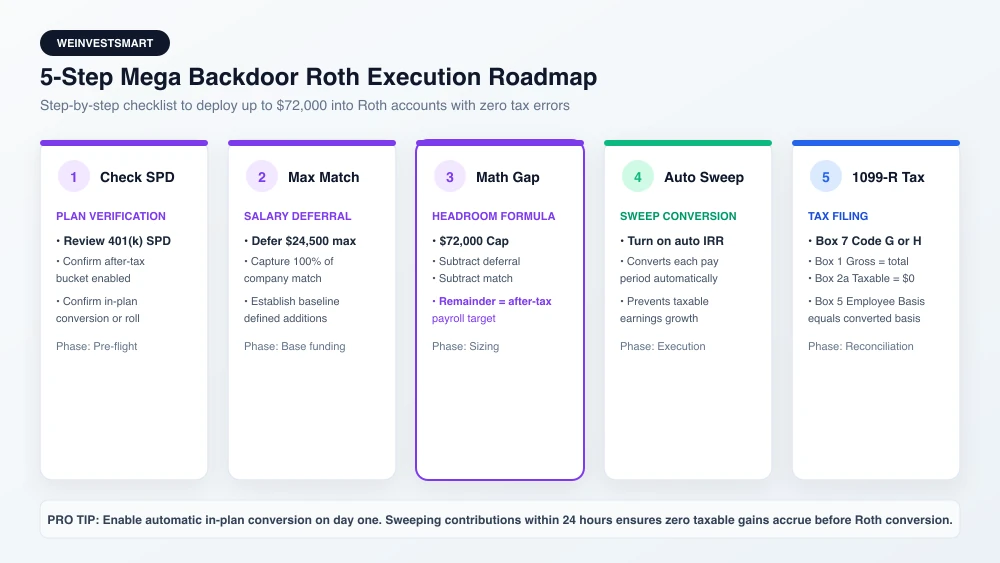
Before adjusting your payroll allocations, contact your human resources benefits department or log into your 401(k) recordkeeper portal to confirm three operational prerequisites:
Prerequisite 1: Voluntary After-Tax Non-Roth Contributions
Your plan must support non-deductible voluntary after-tax contributions. This appears on payroll selection screens as “After-Tax” (distinct from “Pre-Tax” and “Roth”). If your employer only offers Pre-Tax and Roth deferral elections, your plan does not support this strategy.
Prerequisite 2: In-Plan Roth Conversion or In-Service Rollover
Holding money in an after-tax bucket without converting it creates tax friction. The earnings on after-tax contributions grow tax-deferred and are taxed as ordinary income upon withdrawal. To secure tax-free status, your plan must offer either:
- In-Plan Roth Conversion (IRR): Moving after-tax balances directly into the plan’s designated Roth 401(k) sub-account.
- In-Service Non-Hardship Distribution: Permitting active employees to roll after-tax funds out of the company plan and into an external Roth IRA while still employed.
Prerequisite 3: Automated Payroll Sweeps
Many large corporate 401(k) plans (such as those offered by major technology, aerospace, and financial services firms) offer automated daily sweeps. As soon as your after-tax payroll deduction posts, the recordkeeper instantly converts it to Roth status. This eliminates any holding period during which taxable earnings could accumulate.
If your plan requires manual conversion requests, you should schedule conversions every month or quarter to minimize accumulated taxable earnings.
Calculating Your 2026 Contribution Headroom: The IRC §415(c) Formula
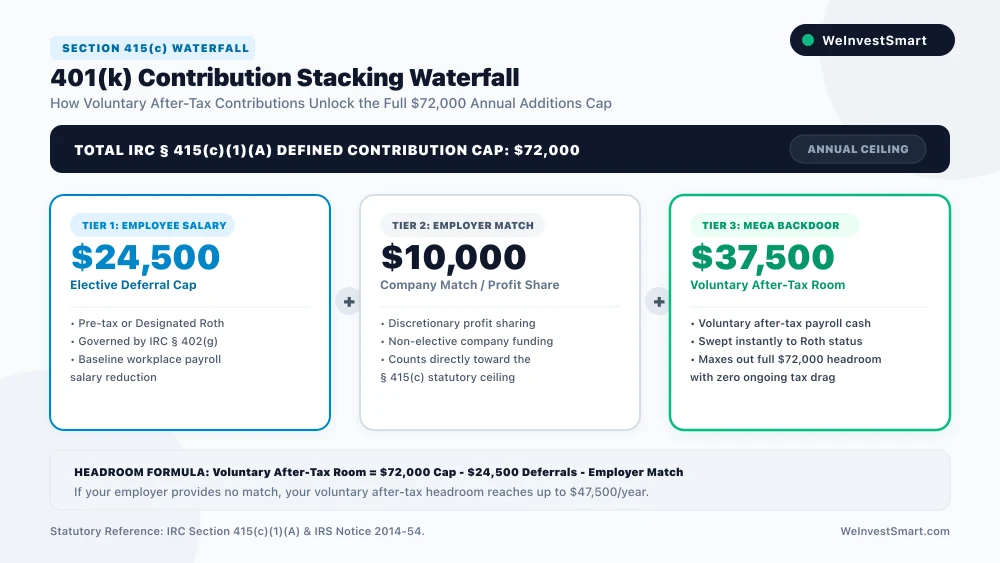
Under Internal Revenue Code Section 415(c)(1)(A), total annual additions to a defined contribution plan cannot exceed $72,000 for the 2026 tax year (up from $70,000 in 2025). This statutory threshold sets the mathematical boundary for your after-tax contributions.
Total additions encompass three specific components: your employee elective deferrals, all employer matching and non-elective profit-sharing contributions, and your voluntary after-tax contributions.
The mathematical formula to determine your annual after-tax headroom is:
Voluntary After-Tax Headroom = $72,000 - Employee Elective Deferrals - Employer Contributions
| Compensation & Match Scenario | Employee Deferral | Employer Match / Profit Sharing | Available After-Tax Headroom | Total 2026 Additions |
|---|---|---|---|---|
| Tech Firm (50% Match on Deferral) | $24,500 | $12,250 | $35,250 | $72,000 |
| Corporate Match (4% on $200k Salary) | $24,500 | $8,000 | $39,500 | $72,000 |
| Executive Match (6% on $300k Salary) | $24,500 | $18,000 | $29,500 | $72,000 |
| No Employer Match Provided | $24,500 | $0 | $47,500 | $72,000 |
Employees who are age 50 or older can contribute an additional $8,000 in catch-up elective deferrals in 2026 (or $11,250 for employees ages 60 to 63 under the SECURE 2.0 Act). Under IRS regulations, catch-up contributions do not count against the Section 415(c) $72,000 ceiling, allowing total savings to exceed $80,000.
Always ensure you coordinate your contribution pace with capturing your company match so you never accidentally crowd out employer matching dollars before year-end.
Execution Pathways: In-Plan Conversion vs. Notice 2014-54 In-Service Rollover
Once your after-tax dollars deposit into your 401(k), you have two distinct operational methods to execute the conversion, depending on your plan rules.
Both pathways achieve the ultimate objective of permanent tax-free compounding, but they involve different custodian mechanics and account destinations:
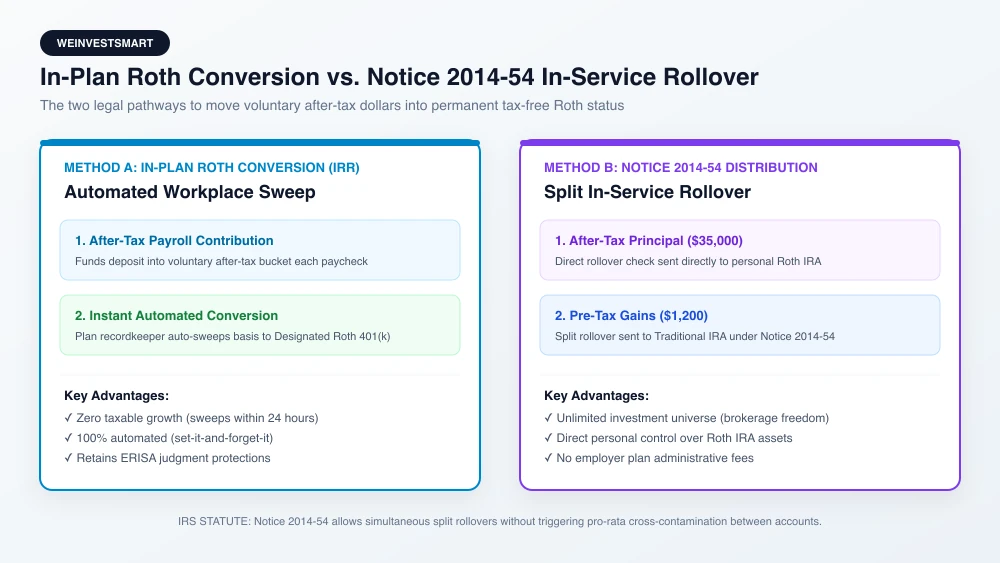
Pathway A: Automated In-Plan Roth Conversion (IRR)
Under IRC Section 402A(c)(4), plans can allow participants to roll non-Roth balances directly into a designated Roth 401(k) account without distributing money from the plan.
When your recordkeeper supports automated conversion, the mechanics are straightforward:
- Salary Allocation: You select a percentage of your salary for after-tax contributions.
- Elect Automated Sweep: You check the box for “Automatic In-Plan Roth Conversion.”
- Instant Payroll Conversion: Every payday, funds flow into the after-tax account and immediately convert into your designated Roth 401(k).
- Zero Tax Drag: Because the transfer happens virtually instantaneously, zero taxable investment gains occur during the transition.
Pathway B: In-Service Non-Hardship Distribution (IRS Notice 2014-54)
If your employer plan does not offer automated in-plan conversions, you can utilize an in-service rollover to move funds to an external Roth IRA. Under IRS Notice 2014-54, the Treasury established landmark guidance allowing taxpayers to execute simultaneous split rollovers:
- Step 1: Direct Transfer of Principal. Your after-tax contribution basis is rolled directly into your personal Roth IRA tax-free.
- Step 2: Split Transfer of Gains. Any pre-tax investment growth that accumulated between contribution and distribution is rolled into a Traditional IRA.
- Step 3: Zero Immediate Tax. Because the untaxed earnings land in a traditional retirement vehicle, you owe zero current income taxes on the transaction.
Notice that if untaxed earnings are sent to a Traditional IRA, that balance could trigger future pro-rata taxes if you also execute regular Backdoor Roth IRAs. In that scenario, completing a 401(k) reverse rollover or simply converting the small earnings amount to Roth and paying the nominal tax is the preferred planning move.
Concrete Case Study: David Maxes the $72,000 Cap
To understand the long-term wealth impact of the Mega Backdoor Roth, consider David, a 38-year-old software engineering director earning $240,000 annually.
David is in the 35% federal marginal tax bracket and already maxes out his standard 401(k) deferral.
David’s Plan Parameters
- Base Salary: $240,000
- Elective Deferral (Pre-Tax): $24,500
- Employer Matching (50% up to 6% of pay): $7,200
- Total Baseline 401(k) Additions: $31,700
- Remaining Section 415(c) Headroom: $72,000 - $31,700 = $40,300
David elects to contribute $40,300 across 24 paychecks ($1,679.17 per pay period) into his plan’s after-tax bucket with automatic in-plan Roth conversion enabled.
Comparative Growth Over Time
If David invested that $40,300 annual surplus in a standard taxable brokerage account versus the Mega Backdoor Roth, annual capital gains taxes and dividend drag would severely compound over time.
| Investment Horizon | Taxable Brokerage (After Tax Drag) | Mega Backdoor Roth (100% Tax-Free) | Net Wealth Advantage |
|---|---|---|---|
| Year 1 Balance | $43,121 | $43,524 | +$403 |
| Year 5 Cumulative | $244,180 | $259,850 | +$15,670 |
| Year 10 Cumulative | $603,240 | $674,210 | +$70,970 |
| Year 20 Cumulative | $1,894,500 | $2,345,600 | +$451,100 |
Assumes a 7.5% annualized nominal rate of return, 2% dividend yield taxed at 20% plus 3.8% NIIT, and capital gains turnover. All numbers rounded to nearest hundred.
By deploying the Mega Backdoor Roth across a 20-year career horizon, David shields over $450,000 in wealth that would otherwise be lost to ongoing tax drag.
To test how long-term compounding scales across different voluntary contribution amounts and investment horizons, model your portfolio growth using our Roth IRA Calculator.
The ACP Non-Discrimination Trap and Corrective Distributions
The greatest potential stumbling block for high-earning employees attempting the Mega Backdoor Roth is non-discrimination testing under federal ERISA regulations.
The IRS requires qualified employer plans to undergo annual testing to verify that contributions do not disproportionately favor Highly Compensated Employees (HCEs).
Under Internal Revenue Code Section 414(q), an employee is classified as an HCE in 2026 if they earned more than $160,000 in the preceding tax year (up from $155,000 in 2025), or if they own more than 5% of the sponsoring business.
How ACP Testing Restricts After-Tax Dollars
While standard elective deferrals are tested under the Actual Deferral Percentage (ADP) test, voluntary after-tax contributions and employer matching dollars are evaluated under the Actual Contribution Percentage (ACP) test governed by IRC Section 401(m).
The average contribution percentage of HCEs cannot exceed the average contribution percentage of non-HCEs by more than specific statutory multipliers (typically 1.25x or 2 percentage points).
Because non-HCE employees rarely make substantial voluntary after-tax contributions, mid-sized and smaller corporate plans frequently fail the ACP test.
What Happens During a Corrective Distribution?
If your employer’s plan fails the ACP test at the conclusion of the plan year, the plan administrator must return excess after-tax contributions to Highly Compensated Employees to restore plan compliance.
When this occurs, the plan initiates four administrative actions:
- Refund Check Issued: The recordkeeper issues a corrective distribution check for the excess after-tax principal and associated earnings.
- Tax-Free Principal Return: The after-tax principal is returned tax-free because you already paid income tax on those dollars.
- Taxable Earnings: Any investment earnings attributable to the refunded contributions are taxable as ordinary income for the tax year in which the distribution occurs.
- Reporting Documentation: You will receive an amended Form 1099-R documenting the refund for your tax return.
If your company has a history of failed ACP tests, the benefits department may cap after-tax contributions at a conservative percentage (such as 5% to 10% of salary) to prevent year-end test failures.
Tax Reporting Reconciliation: Forms 1099-R and 1040
Executing a Mega Backdoor Roth involves transfers between retirement sub-accounts that generate tax reporting documentation with the IRS.
Understanding how to read your annual tax forms ensures you do not inadvertently pay taxes twice on your after-tax contributions:
Reporting In-Plan Roth Conversions (IRR)
When you execute an automated In-Plan Roth Conversion, your 401(k) custodian will issue an IRS Form 1099-R in January following the calendar year of conversion:
- Box 1 (Gross Distribution): Reflects the total dollar amount converted from after-tax to Roth status.
- Box 2a (Taxable Amount): Reflects $0.00 (or the small amount of pre-conversion investment gains that accumulated).
- Box 5 (Employee Contributions / Basis): Matches the after-tax principal converted.
- Box 7 (Distribution Code): Displays Code G (direct rollover) or Code H (direct rollover of designated Roth distribution).
Reporting In-Service Rollovers to an External Roth IRA
If you rolled funds out of the plan into an external Roth IRA, your Form 1099-R will report the transaction under Code G. You report the gross distribution on Form 1040 Line 5a, entering $0.00 on Line 5b if zero taxable gains were distributed.
Crucially, you do not file Form 8606 for an in-plan 401(k) conversion. Form 8606 is reserved exclusively for individual IRA activities as reviewed in our analysis of the Backdoor Roth pro-rata rule. All 401(k) plan conversions are reconciled directly on Form 1040.
Frequently Asked Questions
What is the Mega Backdoor Roth strategy?
The Mega Backdoor Roth is an employer retirement plan strategy that allows employees to make voluntary after-tax non-Roth contributions to their 401(k) beyond the standard elective deferral limit, immediately converting those funds to Roth status.
What is the 401(k) overall contribution limit for 2026?
Under IRC Section 415(c)(1)(A), the total defined contribution plan additions limit from all sources (employee deferrals, employer match, and after-tax contributions) is $72,000 in 2026, up from $70,000 in 2025.
What is the difference between a Roth 401(k) and after-tax 401(k) contributions?
A Roth 401(k) contribution is an elective salary deferral subject to the annual $24,500 limit where future investment earnings grow tax-free. Voluntary after-tax contributions are a separate plan bucket subject to the $72,000 overall limit, whose earnings are taxable upon distribution unless converted to Roth status.
How does an In-Plan Roth Conversion (IRR) work?
An in-plan Roth conversion transfers voluntary after-tax dollars directly into a designated Roth 401(k) sub-account inside the same employer plan, immediately sheltering future investment growth from income taxes.
Does the pro-rata rule affect a Mega Backdoor Roth?
No. The standard IRA pro-rata rule under IRC Section 408(d)(2) applies only to individual IRAs. Employer 401(k) plans are qualified ERISA plans and are legally exempt from IRA aggregation.
This article is for educational purposes only and should not be considered personalized financial advice. Consider consulting with a financial advisor for guidance specific to your situation.
For educational purposes. Consider your own circumstances before making financial decisions. Read our editorial policy.
From reading to planning
Explore the numbers for yourself.
Use our free calculators to compare scenarios and understand your options.